Ambulatory Surgery Center Billing: 7 Challenges Every ASC Must Fix in 2026

Ambulatory Surgery Center Billing in 2026 has become one of the most complex and high-risk areas of healthcare finance. Even a small coding error, missing modifier, or documentation gap can delay payments for weeks or stop them entirely. With Medicare and commercial payers tightening reimbursement rules, ASCs are feeling the pressure like never before.
Industry data shows ASC claim denials and delayed reimbursements continue to rise, while staffing shortages and outdated systems make recovery increasingly difficult. This blog breaks down the most common billing obstacles ASCs face today and exactly how to overcome them using modern, compliant, and revenue-focused strategies.
Why ASC Billing Is Different
Unlike hospitals, ASCs bill only for the facility component, using the CMS-1500 form with POS 24 and ASC-specific modifiers. Medicare’s 9-rate payment system, strict ASC-approved procedure list, and payer-specific bundling rules leave little room for error.
Without specialized ASC medical billing expertise, revenue leakage becomes almost inevitable.
1. Incorrect CPT & HCPCS Coding
Coding errors remain the #1 cause of denied or underpaid claims. A missing SG modifier or outdated CPT code can instantly trigger ASC claim denials, pushing AR days higher and increasing audit exposure.
To avoid denials and underpayments, coders must stay current with ASC-specific coding rules.
Solution:
Train coders on ASC-specific rules only
Apply real-time NCCI and LCD edits
Audit claims weekly
Review operative notes immediately after surgery
2. Incomplete or Inconsistent Documentation
Payers require precise documentation, implant invoices, physician orders, and signed consents. Missing even one element leads to avoidable delays and appeals, a major ASC billing challenges driver.
Solution:
Use standardized procedure templates
Attach implant logs and invoices to charts
Perform monthly documentation audits
Verify chart completeness before claim submission
3. Weak Denial Management Process
Many ASCs never appeal denied claims, permanently losing revenue. A weak denial management process makes recurring issues invisible and weakens overall ASC revenue cycle management.
Solution:
Assign dedicated denial follow-up staff
Track denial trends by payer and CPT
Appeal every recoverable denial
Feed denial insights back to front-end teams
4. Slow Reimbursements & High AR Days
Delayed payments choke cash flow and force ASCs to rely on credit lines. One denied claim can reset the reimbursement clock by months.
Solution:
Submit clean claims within 24 hours
Monitor AR aging daily
Set KPIs like DSO and clean-claim rate
Automate eligibility and claim scrubbing
5. Insurance Eligibility & Authorization Gaps
Failure to verify benefits results in non-covered service denials, one of the most expensive ASC billing challenges.
Solution:
Verify facility and surgeon coverage
Confirm prior authorizations before scheduling
Educate patients on financial responsibility
Escalate repeat payer issues proactively
6. Outdated Billing Technology
Legacy systems lack real-time rule updates and automation, increasing errors and staff burnout. This weakens overall ASC revenue cycle management performance.
Solution:
Upgrade to ASC-specific RCM platforms
Ensure daily CMS & CPT updates
Use dashboards for AR, denials, and forecasts
Integrate EHR and billing workflows
7. Medicare & Payer Compliance Risks
Billing for non-approved procedures or violating payer rules leads to recoupments and compliance exposure. Medicare rules are unforgiving.
Solution:
Monitor CMS ASC Final Rules annually
Bill only ASC-approved procedures
Use POS 24 and correct modifiers consistently
Maintain payer-specific billing references
When It’s Time to Outsource
If denial rates keep rising, staff turnover is high, or technology is holding you back, it may be time to Outsource ASC billing. Many ASCs see immediate improvements in collections, compliance, and reporting accuracy after partnering with specialists.
Choosing to Outsource ASC billing allows leadership to refocus on patient care while experts handle evolving payer rules and complex claims.
Conclusion
Ambulatory Surgery Center Billing doesn’t have to be a constant battle. With the right coding controls, documentation standards, denial workflows, and technology or a trusted billing partner ASCs can dramatically reduce risk and reclaim lost revenue.
In today’s environment, even a small improvement in collections can translate into six-figure gains annually. Fix the gaps now, stay compliant, and protect your ASC’s financial future.
Maximize your ASC revenue, reduce claim denials, and stay fully compliant with Atlantis RCM. Let our expert team handle your Ambulatory Surgery Center Billing, so you can focus on patient care, not paperwork.
📞 Ready to reclaim lost revenue? Schedule a free billing audit with Atlantis RCM today.
Frequently Asked Questions
1. What is Ambulatory Surgery Center billing?
Ambulatory Surgery Center billing is the process of submitting claims for the facility portion of outpatient surgical procedures performed in an ASC. It includes billing for equipment, supplies, implants, and operating room use, typically on a CMS-1500 form with Place of Service 24.
2. Why is ASC billing more complex than physician billing?
ASC billing follows different Medicare payment rules, uses a 9-rate payment system, and requires strict adherence to the ASC-approved procedure list. Physicians bill separately for professional services, while ASCs bill only for facility fees, making errors more likely without specialized knowledge.
3. What are the most common reasons ASC claims are denied?
The most common reasons include incorrect CPT or HCPCS codes, missing modifiers (such as SG), incomplete documentation, lack of prior authorization, and billing for non-covered services under payer or Medicare rules.
4. How can ASCs reduce claim denials and payment delays?
ASCs can reduce denials by submitting clean claims quickly, verifying insurance eligibility before surgery, maintaining complete documentation, auditing claims regularly, and using ASC-specific billing software or expert billing services.
5. When should an ASC consider outsourcing billing?
An ASC should consider outsourcing billing when denial rates increase, reimbursements slow down, staff struggle to keep up with coding updates, or outdated systems cause compliance risks. Outsourcing often improves cash flow and accuracy.
Our Services


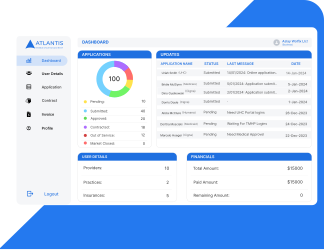
Real-Time Client Report Portal
Access real-time insights into your billing performance with our secure Client Report Portal.Track claims, payments, denials, and KPIs anytime—transparency at your fingertips.
Contact Us