Florida Medicaid DME Fee Schedule 2026: Rates, Codes & Billing Guide

If you bill Florida Medicaid for durable medical equipment or medical supplies, the fee schedule is more than a list of reimbursement amounts.
It can determine whether a claim is paid at the expected rate, whether prior authorization is needed, how many units can be billed, whether an item is rental-only, and whether a service needs special pricing or medical review.
And there is an important 2026 update to know.
Florida Medicaid's current DME and Medical Supply Services Provider Fee Schedule is effective July 1, 2026. Florida's Agency for Health Care Administration (AHCA) provides both an updated PDF and Excel version of the schedule.
This guide explains how to use the Florida Medicaid DME Fee Schedule 2026, what the different columns mean, how to check a HCPCS code, and what DME providers should watch before submitting a claim.
Quick answer: The Florida Medicaid DME fee schedule lists HCPCS codes, maximum reimbursement rates, rental information, billing units, limits, prior authorization indicators, manual pricing, bundled-code indicators, and other billing requirements. The current published schedule is effective July 1, 2026.
Florida Medicaid DME Fee Schedule 2026: What's Current?
Florida Medicaid maintains provider reimbursement schedules through its Rule 59G-4.002, Provider Reimbursement Schedules and Billing Codes resource.
For DME and medical supplies, AHCA currently lists:
- July 1, 2026 updated fee schedule
- July 1, 2026 updated Excel file
- January 1, 2026 updated schedule
- 2025 historical schedule
The July 1, 2026 version is therefore the appropriate starting point when checking current 2026 DME reimbursement information.
This matters because using an older schedule can lead to incorrect expectations about reimbursement, units, or billing requirements.
Official Florida Medicaid DME Fee Schedule
Providers should always verify the code against the current Florida Medicaid schedule rather than relying on an old spreadsheet, third-party rate database, or a previous year's fee schedule.
View the current Florida Medicaid DME Fee Schedule
What Is the Florida Medicaid DME Fee Schedule?
The Florida Medicaid DME fee schedule is the state's published reimbursement reference for covered durable medical equipment, medical supplies, orthotic and prosthetic devices, and related items under the applicable Medicaid program and billing rules.
The schedule identifies the HCPCS code, applicable age range, maximum rate, rental information, billing units, and other indicators that can affect how the service is billed and reimbursed.
It is important to understand that the number beside a HCPCS code is not the only information that matters.
For example, a code may have:
- A maximum fee
- A rental amount
- A unit limit
- A prior authorization requirement
- A manual-pricing designation
- A by-report requirement
- A bundled-code designation
- A time-limited rate
Ignoring those fields can turn an otherwise correct claim into a billing problem.
How to Read the Florida Medicaid DME Fee Schedule
The 2026 schedule contains several columns that DME providers should understand before billing.
1. HCPCS Code
The Code column identifies the Healthcare Common Procedure Coding System code used for the item or service.
For example, the July 2026 schedule includes codes such as:
- A4206
- A4207
- A4230
- A4231
- A9276
- E0163
- E0181
- E0184
These are only examples from the published schedule. Providers should verify the specific code, description, rate, and billing requirements in the current file before submitting a claim.
2. Age
The age column identifies the covered age range associated with the code.
Some codes apply broadly, while others are limited to specific age ranges.
That means a provider should not look at the reimbursement rate alone.
The recipient's age can affect whether the code is applicable.
3. Orthopedic Specialty
Some codes are identified for Orthopedic Specialty (OS).
Florida Medicaid explains that codes identified with "OS" may be reimbursed to physicians with an orthopedic specialty and DME providers, while codes without that designation are only reimbursable to DME providers under the schedule's stated rules.
This is one reason provider type and specialty should be checked before assuming that a particular code can be billed.
4. Maximum Fee
This is one of the most important columns.
Florida Medicaid describes the Maximum Fee as the maximum amount Medicaid will pay for the DME, medical supply, orthotic, or prosthetic device.
The schedule notes that the fee generally represents a unilateral, single item, or each unit unless the description says otherwise. Ostomy supplies have a specific per-stoma or per-fistula convention unless otherwise specified.
For example, the July 2026 schedule lists A4230 at $166.87 and A4231 at $93.48 as maximum rates.
These numbers illustrate why providers should verify the exact HCPCS code rather than using a general category or product name.
Florida Medicaid DME Rates 2026: Examples
The July 1, 2026 schedule contains hundreds of DME and medical supply codes with different maximum rates, unit limits, age ranges, and billing conditions.
Here are a few examples from the current schedule:
HCPCS | July 2026 Maximum Rate | Example Billing Information |
| A4206 | $0.31 | Up to 60 units, 720 per year |
| A4213 | $2.08 | Up to 31 units, 372 per year |
| A4230 | $166.87 | 1 unit, 12 boxes per year |
| A4231 | $93.48 | 1 unit, 12 boxes per year |
| A4232 | $62.06 | 1 unit, 12 boxes per year |
| E0163 | $77.02 | 1 unit, once per 8 years |
| E0181 | $161.38 | Rental information also listed |
| E0184 | $296.68 | Rental information also listed |
These are examples, not a complete rate table. The schedule should be checked for the specific HCPCS code, recipient eligibility, applicable limits, and authorization requirements.
Why the Maximum Rate Is Not the Whole Story
This is where many DME billing mistakes happen.
A provider may find the correct HCPCS code and see a reimbursement amount, but that does not necessarily mean the claim will be paid at that amount.
The same schedule may specify:
- Number of units allowed
- Frequency limits
- Rental-only status
- Daily rental
- Prior authorization
- Manual pricing
- By-report review
- Bundled supplies
- Time-limited rates
For example, Florida Medicaid's July 2026 schedule identifies some codes with PA, some with MP, and some with BR designations.
So the correct billing question is not:
"What does Florida Medicaid pay for this code?"
It is:
"What does Florida Medicaid allow for this code, for this recipient, under these billing conditions?"
What Does PA Mean on the Florida Medicaid DME Fee Schedule?
PA means Prior Authorization.
Florida Medicaid explains that the PA indicator identifies procedure codes that require prior authorization through the applicable fee-for-service delivery system Quality Improvement Organization before the service is performed.
This can also apply to requests to exceed limits or request services not listed on the fee schedule, including E1399.
For DME providers, this is critical.
Submitting a claim first and checking authorization later can create unnecessary denials or payment delays.
Before billing a PA code, verify:
- Recipient eligibility
- Medical necessity
- Required documentation
- Authorization status
- Authorized quantity
- Dates of service
- HCPCS code
- Any applicable limits
What Does MP Mean?
MP means Manually Priced.
The 2026 schedule explains that manually priced services require the reimbursement rate to be negotiated between the provider and the Agency's contracted quality improvement organization.
In other words, providers should not assume that an MP code has a standard fixed reimbursement amount simply because the code appears on the fee schedule.
What Does BR Mean?
BR means By Report.
Florida Medicaid uses this designation for a non-classified procedure code that requires medical review to approve and price the procedure correctly.
When a code is BR, documentation becomes particularly important.
Providers should make sure the medical record and supporting documentation clearly explain:
- What was provided
- Why it was medically necessary
- Why the item was required
- Relevant clinical information
- Any supporting measurements or specifications
What Does RO Mean?
RO means Rental Only.
When an item is designated RO, the equipment remains the provider's property and a monthly fee is reimbursed during the authorized medically necessary period.
This is different from a standard purchase arrangement.
Billing teams therefore need to distinguish between:
Purchase
and
Rental
before submitting the claim.
What Is the Rental Amount?
The Rental Amount column identifies the monthly amount Florida Medicaid reimburses for rental-only and rent-to-purchase items.
The schedule also includes a Daily Rental indicator for items where reimbursement is calculated on a daily rather than monthly basis.
For DME suppliers, this distinction matters because billing the wrong rental structure can result in incorrect claim amounts.
What Does the Units Column Mean?
The Units column identifies the number of units that may be billed for dates of service within the same month.
Florida Medicaid notes that a provider may bill up to a one-month supply for a single billing date based on the recipient's medical need.
This means providers should not simply multiply the maximum fee by any quantity they want.
The code's unit rules and limits need to be checked first.
Understanding DME Limits
The Limit column identifies the maximum limits for a procedure code.
The limits may be expressed as:
- Per month
- Per year
- Every several months
- Per box
- Per item
- A specific number of units
For example, the July 2026 schedule shows codes with limits such as 12 per year, 31 per month, 1 per 8 years, and 1 per 3 years.
This is especially important for recurring medical supplies.
A claim can use the correct HCPCS code and still run into a problem if the quantity exceeds the applicable limit.
What Are Bundled DME Codes?
BC means Bundled Code.
Florida Medicaid explains that when a rental code is bundled, reimbursement includes necessary supplies required to operate the equipment throughout the rental period.
Providers cannot separately bill those included items and must provide replacements when necessary.
This is important when building claims because separate billing of bundled supplies can create avoidable issues.
What Is a Time-Limited Rate?
The Time Limited Rate (TL) indicator identifies a temporary rate assigned because of specific circumstances, such as an emergency or supply shortage.
That means providers should not assume a temporary rate will remain indefinitely.
If a code has a TL designation, check the current schedule and applicable effective dates before billing.
Which DME Categories Are Included?
Florida Medicaid's DME and medical supply schedule covers multiple categories.
The published schedule organizes DME information into categories including areas such as:
- Ostomy supplies
- Wound care supplies
- Diabetic supplies
- Durable medical equipment
- Orthotics and prosthetics
- Enteral and parenteral nutrition
- Respiratory equipment
- Wheelchairs
- Hospital beds
- Ambulatory aids
- Other medical supplies
Florida's Medicaid rules separately identify DME and medical supply policy areas for specialized DME, orthotic and prosthetic services, respiratory services, wheelchairs/hospital beds/ambulatory aids, continence/ostomy/wound care, and enteral/parenteral nutrition.
Florida Medicaid DME Billing: What Providers Should Check
Before submitting a DME claim, your billing team should verify more than the HCPCS code.
1. Confirm eligibility
Make sure the patient is eligible for the applicable Medicaid coverage on the date of service.
2. Confirm the HCPCS code
Verify that the code accurately represents the item or service provided.
3. Check the fee
Review the current maximum rate or applicable pricing method.
4. Check prior authorization
Determine whether PA is required before the service is provided.
5. Check the unit limit
Confirm that the requested quantity is within the schedule's stated limit.
6. Review documentation
Make sure the medical record supports medical necessity and the service billed.
7. Check rental requirements
Determine whether the item is purchased, rental-only, rent-to-purchase, or subject to daily rental.
8. Check bundled services
Make sure supplies included in a bundled code are not billed separately.
9. Check special pricing
Look for MP or BR indicators.
10. Verify the current schedule
This last step is easy to overlook.
Always use the most current Florida Medicaid schedule available for the relevant date of service.
Florida Medicaid DME Fee Schedule vs. Medicare DME Fee Schedule
Do not assume that Florida Medicaid DME reimbursement is the same as Medicare DMEPOS reimbursement.
They are separate payment systems with different rules, schedules, and requirements.
CMS publishes its own Medicare DMEPOS fee schedule files, including 2026 quarterly files such as January, April, and July 2026.
Florida Medicaid, meanwhile, publishes its own DME and medical supply fee schedule.
If you are billing Florida Medicaid, use the applicable Florida Medicaid schedule and billing requirements rather than substituting a Medicare rate.
Does Florida Medicaid Cover Durable Medical Equipment?
Florida law provides for coverage of durable medical equipment when the equipment or device is medically indicated to assist in treating a medical condition and specifically prescribed as medically necessary, subject to applicable limitations. Florida statutes also address prosthetic devices and other artificial aids.
However, coverage does not mean that every item is automatically reimbursable.
Providers still need to consider:
- Covered-service requirements
- Medical necessity
- Recipient eligibility
- HCPCS coding
- Authorization
- Documentation
- Quantity limits
- Fee schedule requirements
- Applicable delivery-system rules
Common Florida Medicaid DME Billing Mistakes
A DME claim can go wrong even when the item itself is covered.
Here are some of the issues billing teams should watch.
Using an outdated fee schedule
A provider may use a 2025 or January 2026 rate when a newer July 2026 schedule applies.
Ignoring the PA indicator
If authorization is required, submitting the claim without the appropriate authorization can create a preventable denial.
Billing too many units
The fee schedule may limit the number of units that can be billed during a month or year.
Missing medical necessity documentation
A code and rate do not replace documentation requirements.
Separately billing bundled supplies
Bundled codes may already include the supplies needed during the rental period.
Treating MP or BR codes like standard-priced codes
Manual pricing and by-report codes require different handling.
Assuming Medicare rates apply
Florida Medicaid and Medicare have separate fee schedules.
Not checking rental requirements
Rental-only equipment must be billed according to the applicable rental rules.
How to Verify a Florida Medicaid DME HCPCS Code
If you are checking a specific code, use this process:
Step 1: Find the HCPCS code
Start with the exact code for the DME or supply.
Step 2: Locate the code in the Florida Medicaid schedule
Search the current PDF or Excel file.
Step 3: Review the maximum rate
Do not stop here.
Step 4: Check the age range
Make sure the recipient meets the applicable age requirement.
Step 5: Review units and limits
Confirm how frequently and how many units may be billed.
Step 6: Look for PA
Determine whether authorization is required.
Step 7: Look for MP, BR, BC, RO, DR, or TL
These indicators can materially change how the item should be billed.
Step 8: Confirm supporting documentation
Make sure the claim is supported before submission.
This approach is much safer than searching for a rate alone.
Why DME Providers Need Accurate Billing
For DME suppliers, reimbursement depends on more than getting a product into the patient's hands.
The billing process has to connect:
Prescription → Medical necessity → Authorization → HCPCS coding → Documentation → Claim → Adjudication → Payment
A problem anywhere in that chain can affect reimbursement.
For example:
Wrong HCPCS → incorrect claim
Missing authorization → denial
Excess units → claim issue
Insufficient documentation → payment problem
Incorrect rate → underpayment
That is why DME billing requires close attention to both the fee schedule and the supporting documentation.
How a DME Billing Team Can Reduce Denials
A good DME billing workflow should catch problems before claims reach the payer.
A practical pre-submission review can include:
Eligibility check
↓
HCPCS verification
↓
Authorization check
↓
Documentation review
↓
Unit and limit validation
↓
Fee schedule verification
↓
Claim submission
↓
Claim status follow-up
↓
Payment posting
↓
Denial and A/R follow-up
This approach helps separate a simple claim submission process from a complete revenue cycle process.
Frequently Asked Questions
What is the Florida Medicaid DME Fee Schedule for 2026?
It is the Florida Medicaid reimbursement schedule for durable medical equipment and medical supplies, containing HCPCS codes, maximum rates, rental information, units, limits, authorization indicators, and other billing requirements. The current updated version listed by AHCA is effective July 1, 2026.
Where can I find the Florida Medicaid DME Fee Schedule 2026?
The schedule is published by the Florida Agency for Health Care Administration under Rule 59G-4.002. AHCA provides both PDF and Excel versions of the current DME fee schedule.
What is the current effective date of the Florida Medicaid DME fee schedule?
The current updated DME and Medical Supply Services Provider Fee Schedule listed by Florida AHCA is effective July 1, 2026.
Does every DME code have a fixed reimbursement rate?
No. Some codes may be manually priced or require by-report review. The schedule also identifies rental amounts, bundled codes, prior authorization requirements, and other special conditions.
What does PA mean on the Florida Medicaid DME schedule?
PA means Prior Authorization. The schedule uses this designation for codes requiring prior authorization through the applicable Florida Medicaid fee-for-service process before the service is performed.
What does MP mean?
MP means Manually Priced. The reimbursement rate must be negotiated between the provider and the applicable Agency-contracted quality improvement organization.
What does BR mean?
BR means By Report. The procedure requires medical review to approve and price the service appropriately.
Can I use Medicare DME rates for Florida Medicaid?
No. Medicare and Florida Medicaid maintain separate reimbursement systems. CMS publishes Medicare DMEPOS fee schedules separately from Florida Medicaid's DME schedule.
Does Florida Medicaid have limits on DME supplies?
Yes. The Florida Medicaid schedule includes a Limit field showing maximum limits for applicable procedure codes. Limits can vary by code and may be expressed by month, year, or another specified period.
Final Takeaway
The Florida Medicaid DME Fee Schedule 2026 should not be treated as simply a list of reimbursement rates.
The current July 1, 2026 schedule contains information that can affect the entire claim, including:
- HCPCS codes
- Maximum fees
- Age ranges
- Rental amounts
- Daily rental
- Units
- Limits
- Prior authorization
- Manual pricing
- By-report review
- Bundled codes
- Time-limited rates
For DME suppliers, checking all of these fields before billing can help prevent avoidable claim issues and reimbursement delays.
If your team is spending too much time dealing with DME claims, denials, authorization requirements, or unpaid A/R, the problem may not be the fee schedule alone. It may be the process used to turn that information into a clean, payable claim.
Need help managing DME billing and claims? Atlantis RCM provides medical billing, claims management, denial management, A/R management, and revenue cycle support for healthcare organizations.
Request a Free Medical Billing Assessment
Official source
The Florida Agency for Health Care Administration should be treated as the primary source for the current Florida Medicaid DME fee schedule. The July 1, 2026 schedule is available in both PDF and Excel formats through AHCA's provider reimbursement schedule page.
Our Services


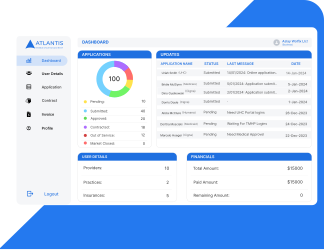
Real-Time Client Report Portal
Access real-time insights into your billing performance with our secure Client Report Portal.Track claims, payments, denials, and KPIs anytime—transparency at your fingertips.
Contact Us