Florida occupational therapy providers need more than the correct CPT code to get Medicaid claims paid. Reimbursement depends on using the applicable fee schedule, reporting the right modifier, staying within service limits, meeting coverage requirements, and maintaining documentation that supports the care provided.
For 2026, the Florida Agency for Health Care Administration (AHCA) lists a dedicated Occupational Therapy Services Fee Schedule effective January 1, 2026. The schedule includes maximum fees and allowable units for evaluation, treatment, wheelchair management, and casting or strapping services.
For occupational therapy practices, understanding these rates is important for estimating reimbursement, configuring billing systems, reviewing claims, and identifying potential payment issues within their medical billing workflow.
This guide breaks down the Florida Medicaid occupational therapy fee schedule for 2026, including key CPT codes, modifiers, maximum fees, service limits, coverage considerations, and billing issues OT providers should review.
Important: The amounts shown below are Florida Medicaid's published maximum fees. They should not be treated as a guaranteed payment for every claim. Provider enrollment, member eligibility, managed care participation, authorization requirements, coverage rules, and plan-specific requirements can affect reimbursement.
Florida Medicaid Occupational Therapy Fee Schedule 2026
The following rates come from Florida AHCA's official 2026 Occupational Therapy Services Fee Schedule, effective January 1, 2026.
The official AHCA schedule identifies these amounts as maximum fees, along with the applicable modifiers and unit limits.
What Changed for 2026?
The 2026 schedule became effective January 1, 2026. AHCA's provider reimbursement schedule page specifically lists the Occupational Therapy Services Fee Schedule with a January 1, 2026 effective date.
AHCA also reports a 0.71% fee schedule increase for occupational therapy services under its provider minimum-wage fee schedule information.
For billing teams, the important point is not simply knowing that rates changed. The fee schedule in the billing system should correspond to the applicable 2026 schedule and the provider's billing arrangement.
Florida Medicaid OT Evaluation Codes: 97165, 97166, 97167 and 97168
The 2026 schedule assigns the same maximum fee of $58.11 to CPT codes 97165, 97166, 97167, and 97168.
That does not mean the codes are interchangeable.
CPT 97165: Low-Complexity OT Evaluation
CPT 97165 represents a low-complexity occupational therapy evaluation.
The complexity level should be supported by the clinical circumstances and documentation. A practice should not select an evaluation code simply because all three initial evaluation codes have the same Florida Medicaid maximum fee.
CPT 97166: Moderate-Complexity OT Evaluation
CPT 97166 represents a moderate-complexity OT evaluation.
The medical record should support why the patient's condition and occupational performance require the level of evaluation reported.
CPT 97167: High-Complexity OT Evaluation
CPT 97167 represents a high-complexity OT evaluation.
Again, the fact that Florida Medicaid lists the same maximum fee for 97165, 97166, and 97167 does not eliminate the requirement to report the code that accurately describes the service.
CPT 97168: OT Re-Evaluation
CPT 97168 represents an occupational therapy re-evaluation.
The 2026 Florida Medicaid fee schedule allows one 97168 re-evaluation every five months and lists a maximum fee of $58.11.
Providers should also distinguish the fee schedule's unit limit from authorization requirements that may apply through a member's specific Medicaid managed care plan.
Florida Medicaid OT Treatment Rates
Several commonly used occupational therapy treatment codes have a 2026 maximum fee of $20.33 under the AHCA schedule.
These include:
- 97530 with GO: OT treatment provided by an occupational therapist
- 97535: Self-care and home management training
- 97110 with GO: Therapeutic procedure
- 97755: Assistive technology
The schedule generally limits these treatment services to four units per day and 14 units per week.
This makes unit tracking an important part of OT revenue cycle management.
A provider could deliver medically appropriate care but still encounter a reimbursement issue if the claim exceeds an applicable unit limitation or does not meet another coverage or authorization requirement.
CPT 97530: GO vs. HM Modifier
One of the most important distinctions in the 2026 schedule is CPT 97530.
The schedule lists:
97530 + GO
- Occupational therapy treatment visit provided by an occupational therapist
- Maximum fee: $20.33
97530 + HM
- Occupational therapy treatment visit provided by an occupational therapy assistant
- Maximum fee: $16.28
Both are subject to the schedule's four-unit-per-day and 14-unit-per-week limitation.
This means billing teams need accurate information about who performed the service before submitting the claim.
A modifier should never be selected simply to obtain a higher reimbursement amount. The claim must accurately represent the service performed and the provider involved.
Other Important Florida Medicaid OT Codes
CPT 97542: Wheelchair Management and Training
Florida Medicaid's 2026 schedule lists CPT 97542 with the GO modifier at a maximum fee of $36.38.
The schedule allows up to four visits per state fiscal year.
The Florida Medicaid OT coverage policy also identifies wheelchair evaluations and related follow-up services as part of the occupational therapy benefit.
CPT 29799: Casting or Strapping
CPT 29799 is listed with HA and GO modifiers and a 2026 maximum fee of $22.27.
The schedule allows a maximum of two applications per day.
Because modifier combinations and service limits can affect claim processing, billing teams should verify that the submitted claim matches the applicable AHCA requirements.
Florida Medicaid Occupational Therapy Coverage and Eligibility
A fee schedule alone does not determine whether a service will be reimbursed.
Florida AHCA states that Medicaid occupational therapy services include castings and strappings, evaluations, and treatment.
AHCA's therapy services information also explains that occupational therapy services are provided by licensed, Medicaid-participating occupational therapists and supervised occupational therapy assistants.
Eligibility and coverage can depend on the recipient's age and Medicaid program.
For example, AHCA states that Medicaid recipients age 20 and younger who are not in a long-term care plan may receive occupational therapy according to the applicable coverage and limitations policy. Recipients age 21 and older may receive limited occupational therapy services related to wheelchair evaluations and fittings under the referenced program information.
Providers should therefore verify the patient's eligibility and applicable coverage before assuming that a service listed on the fee schedule is automatically payable.
Florida Medicaid OT Unit and Frequency Limits
Unit limits are one of the areas where billing errors can quickly affect reimbursement.
For several common treatment codes, the 2026 schedule establishes:
Maximum daily limit: 4 units
Maximum weekly limit: 14 units
This applies to the listed services including 97530, 97535, 97110, and 97755.
Other services have different limits.
For Example:
- 97165: 1 per year
- 97166: 1 per year
- 97167: 1 per year
- 97168: 1 per 5 months
- 97542: 4 per year
- 29799: 2 per day
These limits should be incorporated into the practice's billing workflow rather than checked only after a claim has already been rejected.
Florida Medicaid OT and Managed Care Billing
Florida Medicaid includes managed care programs, so providers should not assume that the fee schedule alone answers every billing question.
AHCA's Managed Medical Assistance program materials identify occupational therapy as a covered service under the 59G-4.318 Occupational Therapy Services Coverage Policy and reference the Occupational Therapy Services Fee Schedule. The same materials identify the TL modifier requirement for the applicable MMA program.
This is important because an OT practice may treat Medicaid patients enrolled in different plans, and authorization or billing requirements can vary by plan.
Before submitting a claim, billing teams should verify:
- Member eligibility
- Medicaid plan
- Provider participation status
- Prior authorization requirements
- Authorized units
- CPT code
- Applicable modifiers
- Date of service
- Diagnosis coding
- Documentation requirements
- Applicable plan billing instructions
The 2026 fee schedule should therefore be used together with the applicable Florida Medicaid coverage policy and plan requirements, not as a standalone billing rule.
Documentation Matters as Much as the Fee Schedule
Correct reimbursement starts with a claim that accurately represents the care delivered.
Florida Medicaid's occupational therapy coverage policy establishes medical necessity and documentation requirements for services covered under the OT benefit. The policy also identifies services and circumstances that are not covered.
For OT providers, documentation should support the service reported on the claim and provide a clear connection between the patient's condition, treatment, and plan of care.
Billing teams should pay particular attention when:
- The evaluation complexity changes
- A re-evaluation is submitted
- Multiple treatment units are billed
- An OTA provides treatment
- Authorization limits apply
- Wheelchair services are billed
- A claim is denied for medical necessity or frequency
- Documentation is requested during an audit
A correct CPT code with insufficient supporting documentation can still create a reimbursement problem.
Common Florida Medicaid OT Billing Issues to Watch in 2026
1. Using the Wrong Modifier
The 2026 fee schedule distinguishes between certain services based on modifiers, including the GO and HM modifiers for CPT 97530.
2. Exceeding Unit Limits
Billing more units than the applicable daily, weekly, or annual limit can result in claim payment issues.
3. Ignoring Authorization Requirements
The fee schedule does not replace the need to verify authorization requirements applicable to the patient's Medicaid plan.
4. Selecting an Evaluation Code Based on Reimbursement
Because 97165, 97166, and 97167 have the same listed maximum fee, providers should not select a complexity level based on payment.
The clinical record should support the code reported.
5. Treating Every Medicaid Patient the Same
Eligibility, program participation, managed care enrollment, provider status, and plan requirements can affect how a claim should be handled.
6. Failing to Review Denials
A rejected or denied OT claim should be reviewed for the underlying cause rather than simply resubmitted repeatedly.
A structured denial management process can help providers identify recurring reasons for rejected or denied claims and address patterns instead of handling each claim in isolation.
How OT Practices Can Protect Revenue in 2026
A strong occupational therapy billing workflow should connect clinical documentation with coding, authorization, claim submission, payment posting, and follow-up as part of a broader revenue cycle management process.
Before submitting Florida Medicaid claims, practices should establish a process for checking:
Patient → Eligibility → Plan → Authorization → CPT → Modifier → Units → Documentation → Claim → Payment

This approach gives billing teams a better opportunity to identify errors before submission.
It also makes it easier to determine whether a payment issue resulted from coding, authorization, eligibility, documentation, unit limits, or another claim-processing issue.
For practices with recurring Medicaid denials or unresolved accounts receivable, a focused medical billing audit can help identify patterns that may otherwise remain hidden in individual claims.
Florida Medicaid Occupational Therapy Fee Schedule 2026: Key Takeaways
Florida's 2026 Occupational Therapy Services Fee Schedule provides maximum fees and service limits for a range of OT services.
The most frequently referenced amounts include:
- 97165: $58.11
- 97166: $58.11
- 97167: $58.11
- 97168: $58.11
- 97530 + GO: $20.33
- 97530 + HM: $16.28
- 97535: $20.33
- 97110 + GO: $20.33
- 97755: $20.33
- 97542 + GO: $36.38
- 29799 + HA + GO: $22.27
But the rate alone is not enough.
Florida occupational therapy providers should also verify eligibility, coverage, authorization, CPT coding, modifiers, unit limits, documentation, and managed care requirements before assuming that a claim will be reimbursed.
For OT practices, getting these details right is part of protecting revenue, reducing avoidable denials, and maintaining a reliable billing process.
Need Help Reviewing Your OT Billing?
If your Florida occupational therapy practice is seeing recurring Medicaid denials, coding issues, authorization-related rejections, or unexplained A/R, Atlantis RCM can review the billing workflow and identify opportunities for improvement.
Request a Free Medical Billing Audit to evaluate your claims, coding, denials, A/R, and revenue cycle performance.
Our Services


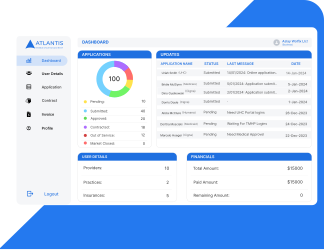
Real-Time Client Report Portal
Access real-time insights into your billing performance with our secure Client Report Portal.Track claims, payments, denials, and KPIs anytime—transparency at your fingertips.
Contact Us