How Predictive Revenue Cycle Analytics Improve Financial Performance

Your practice may be delivering great care, but hidden revenue issues could still be affecting your financial health.
Rising denials.
Delayed payments.
Growing accounts receivable.
“The challenge?”
Most providers discover these problems after the revenue loss has already happened.
“What if you could predict these risks before they impact your cash flow?”
Predictive revenue cycle analytics helps practices identify claim trends, payer issues, and workflow gaps early so they can make smarter decisions, prevent revenue leakage, and improve financial performance.
Why Traditional Revenue Cycle Reporting Is No Longer Enough
Most practices rely on historical reports to evaluate their financial performance. These reports explain what happened last month or last quarter, but they rarely help providers understand what is likely to happen next.
Healthcare reimbursement has become more complex. Payer requirements change frequently, claim edits evolve, and patient financial responsibility continues to grow.
Looking only at historical data leaves practices one step behind.
Predictive analytics gives providers the ability to identify patterns before they become costly problems, helping leadership take action with confidence instead of reacting under pressure.
Understanding Predictive Revenue Cycle Analytics
At its core, predictive revenue cycle analytics uses historical billing data, payer behavior, claim trends, and financial patterns to estimate future outcomes. Rather than simply measuring performance, it helps answer questions such as:
Will denial rates increase next month?
Which payer is creating the greatest reimbursement delays?
Which claims have the highest probability of rejection before they are even submitted?
These insights help practices prioritize resources where they can make the greatest financial impact.
Instead of guessing, providers can make decisions backed by real operational data.
Earlier Risk Detection Protects Practice Revenue
Many billing problems don't happen overnight.
A gradual increase in coding errors, documentation gaps, authorization issues, or payer-specific edits often develops over weeks before becoming visible in financial reports.
For providers, this means fewer surprises and greater financial stability throughout the year.
Early visibility also supports better collaboration between clinical staff, coders, and billing teams, creating a stronger overall revenue cycle management process.
Better Decision-Making Through Healthcare Analytics
Every healthcare organization wants to improve financial performance, but successful decisions require reliable information.
Modern healthcare analytics transforms billing data into meaningful business intelligence that leaders can actually use.
As financial pressures continue to increase across healthcare, data-driven decision-making is becoming a competitive advantage rather than a luxury.
Predicting Claim Denials Before They Happen
Claim denials remain one of the largest sources of lost revenue for medical practices.
Many organizations focus heavily on appeals, but appealing claims requires time, staff resources, and additional administrative costs.
A stronger strategy is preventing denials before they occur.
This proactive approach strengthens denial management, improves first-pass claim acceptance, and helps practices maintain healthier cash flow without increasing administrative workload.
Improving Payer Performance With Predictive Insights
One of the biggest challenges providers face is understanding why some claims move smoothly while others experience repeated delays.
With predictive revenue cycle analytics, practices can identify payer patterns and understand where reimbursement challenges are most likely to occur.
This insight helps billing teams focus on high-risk areas, improve claim preparation, and create better strategies for managing payer relationships.
Forecasting Cash Flow With Greater Accuracy
Financial planning becomes difficult when practices cannot predict when payments will arrive.
Unexpected delays in reimbursement can affect staffing decisions, technology investments, and daily operations.Predictive analytics helps providers understand future revenue trends by analyzing historical payment cycles, outstanding claims, and reimbursement patterns.
Better forecasting creates stability because providers have a clearer picture of expected revenue instead of relying only on past performance reports.
Improving Revenue Cycle Performance Through Data
A strong revenue cycle depends on knowing where improvements are needed.Many practices track basic numbers such as collections and outstanding balances, but these metrics do not always explain the reasons behind financial challenges.
Predictive insights provide a deeper view of revenue cycle performance by identifying workflow issues, claim delays, and areas where revenue may be lost.
For example, analytics can highlight whether problems are linked to documentation, coding, payer requirements, or internal processes.With this information, providers can improve their workflows and create a more efficient billing operation.
Supporting Smarter Billing Strategies
Technology is changing how medical practices manage their financial operations.
Modern medical billing services now use advanced analytics to improve accuracy, reduce manual effort, and identify opportunities for better reimbursement.Predictive tools help billing teams prioritize important tasks, such as reviewing high-risk claims, following up on delayed payments, and addressing recurring billing issues.
Preparing for the Future of Healthcare Reimbursement
Healthcare reimbursement continues to evolve with changing payer expectations, new regulations, and increasing administrative pressure.
Practices that depend only on traditional reporting may struggle to adapt quickly. Predictive analytics in healthcare gives providers the ability to prepare for changes by identifying trends before they create financial disruption.
Whether it is changing payer behavior, rising denial risks, or shifting reimbursement patterns, predictive insights help practices stay prepared.
Turning Data Into Financial Growth
Predictive analytics is not about replacing human expertise. It is about giving healthcare teams better information to make stronger decisions.
When providers understand where revenue risks exist, they can improve processes, reduce unnecessary losses, and create a more predictable financial environment.
A proactive approach to billing allows practices to focus less on fixing problems and more on improving long-term performance.
Conclusion
Predictive revenue cycle analytics gives providers the visibility they need to identify risks, improve reimbursement, and strengthen financial performance.
Atlantis RCM helps healthcare providers use smarter revenue cycle strategies to reduce billing challenges, improve collections, and protect practice revenue.
Partner with Atlantis RCM to turn billing data into better financial outcomes.
FAQs:
1. How can predictive revenue cycle analytics help my medical practice?
Ans: It helps identify revenue risks early, reduce claim issues, and improve reimbursement decisions using real-time data insights.2. Can predictive analytics help reduce claim denials?
Ans: Yes, it identifies patterns behind denials and helps teams fix issues before claims are submitted.3. Do I need a large practice to benefit from revenue cycle analytics?
Ans: No, practices of all sizes can use analytics to improve cash flow, billing efficiency, and financial visibility.4. How does predictive analytics improve reimbursement performance?
Ans: It helps providers understand payer trends, claim delays, and workflow gaps that impact timely payments.5. Will predictive analytics replace my billing team?
Ans: No, it supports billing teams by providing better insights so they can make faster and more accurate decisions.Our Services


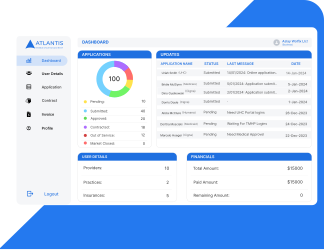
Real-Time Client Report Portal
Access real-time insights into your billing performance with our secure Client Report Portal.Track claims, payments, denials, and KPIs anytime—transparency at your fingertips.
Contact Us