Running a small medical practice means every hour and every dollar matters. Physicians and practice owners balance patient care with scheduling, insurance verification, coding, claim submission, payment posting, denials, accounts receivable, and patient billing.
That is why medical billing services for small practices can be valuable. The right partner can provide specialized billing support without requiring a large in-house team.
But outsourcing is not simply about sending claims. A strong billing partner should understand the practice’s specialty, payer mix, technology, documentation, and goals.
This guide explains what small practices should expect from professional billing services, what to evaluate before outsourcing, and how support can affect collections, denials, A/R, and operations.
Why Medical Billing Is Difficult for Small Practices
Small practices often operate with lean administrative teams. One employee may handle scheduling, registration, insurance verification, referrals, prior authorization, patient calls, and billing.
That becomes difficult when claim volume increases.
A missed eligibility check can cause a denial. An incorrect CPT or ICD-10 code can delay payment. Missing authorization can stop reimbursement. An unpaid claim that is not followed up can remain in A/R for months.
Large health systems may have separate specialists for coding, claims, denials, payment posting, and A/R. A small practice may expect one or two employees to manage many responsibilities.
That means billing issues can compete directly with patient care and practice growth.
What Do Medical Billing Services for Small Practices Include?
A complete billing service should cover more than claim submission. The exact scope varies, but small practices should look for support across the revenue cycle.
Patient Registration and Insurance Verification
Accurate patient demographics and insurance information support clean claims. Billing teams may verify coverage, benefits, copays, deductibles, and other payer information before services are provided.
Medical Coding
Accurate coding connects the services documented by the provider with the codes reported to the payer. Depending on the specialty, this may involve CPT, HCPCS, and ICD-10-CM codes.
Coding errors can contribute to rejections, denials, payment delays, and compliance concerns. Ask whether the billing company provides dedicated medical coding support or works only from codes supplied by your practice.
Charge Entry and Claim Submission
After services are documented and coded, charges must be entered accurately and claims submitted within applicable payer and contractual timeframes.
A strong workflow includes claim review before submission and rejected-claim monitoring.
Payment Posting
Payment posting records payer and patient payments, adjustments, contractual amounts, and remaining balances. Accurate posting gives practice owners a clearer picture of what has been collected and what remains outstanding.
Denial Management and A/R Follow-Up
A denial should not simply become an unpaid balance.
The billing team should identify the denial reason, determine whether correction or appeal is appropriate, submit the response, and track the claim through resolution.
A/R follow-up focuses on unpaid claims and balances. Practices should know how their partner monitors aging accounts, contacts payers, and prioritizes older or higher-value balances.
Reporting and Revenue Visibility
Outsourcing billing should not mean losing visibility. A practice should receive useful reports covering claims, payments, denials, A/R aging, and collections.
What Should a Small Practice Look for in a Medical Billing Company?
Not every billing company is built around the needs of small practices. Evaluate the service model, not just the advertised percentage or monthly fee.
Specialty Experience
Medical billing differs across specialties. Primary care, behavioral health, orthopedics, therapy, cardiology, and other specialties can have different coding, authorization, documentation, and payer requirements.
Ask whether the billing team understands your specialty and the services you actually bill.
Payer Knowledge
Small practices may work with Medicare, Medicaid, commercial insurers, Medicare Advantage, and other payers. Your billing partner should understand payer-specific requirements.
Communication
Small practices need direct answers. Ask who manages your account, how often you receive updates, how billing questions are handled, and how issues are escalated.
Technology Integration
The billing company should be able to work with your EHR or practice management system. Accurate information exchange and reliable reporting are essential to a workable billing process.
Atlantis RCM states that its billing systems can integrate with many small-practice management systems and provide reporting on billing performance, payments, and claim status.
HIPAA and Data Security
Medical billing involves protected health information. Ask how a billing company handles access, transmission, storage, security, and HIPAA responsibilities.
How Can Outsourcing Medical Billing Help a Small Practice?
Outsourcing is not simply about removing administrative tasks. It gives the practice access to specialized billing resources without requiring every function to be handled internally.
Reduce Administrative Work
Outsourcing can move repetitive billing tasks away from clinical and front-office staff, allowing employees to spend more time on patients and practice operations.
Improve Claim Follow-Up
Claims require attention after submission. A dedicated billing team can monitor unpaid claims, investigate denials, and follow up with payers instead of allowing unresolved claims to age.
Identify Revenue Leakage
Revenue can be lost through coding errors, missed charges, eligibility problems, underpayments, denials, untimely filing, and weak A/R follow-up.
Regular reporting and claim reviews can help identify recurring patterns.
Support Cash Flow
Consistent claim submission, denial follow-up, payment posting, and A/R management can reduce avoidable delays and give practice owners better visibility into expected collections.
When Should a Small Practice Consider Outsourcing?
Outsourcing may be worth evaluating when:
Billing tasks take too much time away from patient-facing work.
Claims are frequently rejected or denied.
A/R is aging without consistent follow-up.
The practice has difficulty hiring or retaining experienced billers.
The physician or practice manager is personally handling billing issues.
Revenue is difficult to track.
The practice is adding providers or locations.
Billing volume has increased.
A new practice needs a billing process from the beginning.
A practice does not have to wait until billing becomes a major problem. Outsourcing can be evaluated when workload exceeds the team's capacity.
What Should You Ask Before Signing a Billing Contract?
Before choosing a medical billing company, ask:
Who handles coding?
Does the company provide eligibility verification?
How are claims reviewed before submission?
How are rejected and denied claims handled?
How often is A/R followed up?
What reports will the practice receive?
Which EHR or practice management systems are supported?
How is patient information protected?
Who is the primary point of contact?
How are payer issues escalated?
What happens to unresolved claims if the contract ends?
Ask how performance is measured. Useful metrics include clean claim rate, denial rate, days in A/R, net collection rate, payment turnaround, and A/R aging.
Medical Billing vs. In-House Billing
For some small practices, in-house billing can work well. An experienced biller who understands the practice, specialty, and payer mix can provide valuable continuity.
The challenge is coverage. If one employee leaves or becomes overloaded, important billing tasks may be delayed.
Outsourcing can provide access to multiple billing functions without requiring separate employees for coding, claims, denials, payment posting, and A/R.
The better option depends on the practice’s volume, staffing, specialty, technology, budget, and control needs.
Why Billing and RCM Should Work Together
Billing does not operate separately from the rest of the revenue cycle.
Eligibility, authorization, coding, documentation, charge capture, claim submission, payment posting, denial management, and A/R all affect one another.
A missed authorization can create a denial. A coding mismatch can delay payment. Incorrect patient information can cause a rejection. Weak A/R follow-up can leave a valid claim unpaid long after submission.
That is why small practices should look beyond a company that only submits claims. A broader revenue cycle management approach connects front-end and back-end processes and helps identify where revenue is being delayed.
Why Atlantis RCM Supports Small Medical Practices
Atlantis RCM provides medical billing support for small practices, covering verification, claim submission, follow-up, payment posting, denial management, A/R recovery, coding, and reporting. Its small-practice service page also emphasizes specialty-focused billing, claim accuracy, compliance, end-to-end support, reporting, and technology integration.
For practices considering outsourcing, Atlantis RCM offers a free medical billing audit designed to identify revenue leaks and missed opportunities before a practice decides how to improve its billing process.
The goal is not to make a small practice operate like a hospital. It is to provide billing expertise and consistent follow-up without unnecessary administrative pressure.
Final Takeaway
Medical billing services for small practices can provide specialized support without requiring a practice to build a large internal revenue cycle department.
The best partner is not necessarily the company with the lowest fee. It understands the practice’s specialty, payer mix, coding, claims, denials, A/R, technology, and goals.
Before outsourcing, review the complete billing process from patient registration through final payment. Look at denial patterns, aging A/R, claim quality, reporting, staff workload, and the expertise available internally.
If those areas are consuming too much time or leaving revenue unresolved, outsourcing medical billing may be worth evaluating.
For small practices looking for a clearer picture of their current billing performance, a free medical billing audit can be a practical first step.
Our Services


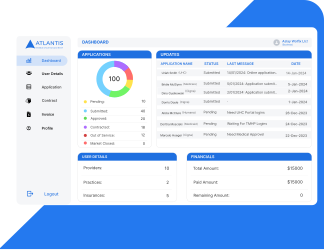
Real-Time Client Report Portal
Access real-time insights into your billing performance with our secure Client Report Portal.Track claims, payments, denials, and KPIs anytime—transparency at your fingertips.
Contact Us