Medical Credentialing in 2026: The Complete Guide for Providers

Getting a new provider approved should not feel like a race against payer deadlines.
Yet outdated licenses, incomplete CAQH profiles, mismatched enrollment data, or delayed applications can quickly hold up the process.
Medical Credentialing is more than paperwork. It can affect when providers join payer networks, begin billing, and start contributing to practice revenue.
So, what does credentialing involve in 2026, and how can providers avoid unnecessary delays?
Why Credentialing Matters More in 2026
Healthcare administration is becoming increasingly connected.
Provider information can move between credentialing platforms, payer systems, enrollment portals, EHR workflows, and revenue cycle operations. A small discrepancy can therefore create problems somewhere else in the workflow.
For example, CMS states that providers generally need to revalidate Medicare enrollment periodically, with PECOS providing an online way to review information, upload documents, sign, and submit revalidation applications.
CMS also requires providers to keep enrollment information current, including reporting certain changes within specific timeframes.
This makes data maintenance just as important as the initial application.
For providers, the question is no longer simply:
“Did we credential this physician?”
It is:
“Is every piece of provider information still accurate wherever it needs to be?”
Initial Credentialing vs. Re-Credentialing
Not every credentialing task happens when a provider joins a practice.
Initial Credentialing
Initial credentialing occurs when a provider is being evaluated for the first time by a healthcare organization, payer, or network.
This can involve reviewing:
Education and training
Medical licenses
Board certifications
Work history
Malpractice coverage
Professional references
NPI information
Practice locations
Payer-specific documentation
The exact requirements can vary by payer, specialty, state, and provider type.
Re-Credentialing
Re-credentialing is the recurring review of a provider’s information to confirm that the provider continues to meet participation requirements.
This is where practices can get caught off guard.
A provider may have been properly approved years ago, but an expired license, outdated practice address, or missing documentation can still create an administrative problem today.
CAQH, for example, requires providers to periodically re-attest their information, with the standard cycle generally being every 120 days and a different cycle applying to Illinois providers.
The Medical Credentialing Process: Step by Step
A modern medical credentialing process usually follows several connected stages.
1. Collect Provider Information
The process begins by gathering the provider’s professional and practice information.
This may include licenses, education, training, work history, certifications, malpractice insurance, NPI details, and other supporting documents.
The biggest challenge is often not collecting the information, it is keeping all of it consistent.
2. Verify the Credentials
The information is then checked against appropriate primary or authoritative sources.
Licenses, education, training, certifications, and professional history may need to be independently verified before the application can move forward.
3. Complete Payer Enrollment
Credentialing and enrollment are closely connected, but they are not identical.
A provider can be clinically qualified while still needing payer enrollment before the practice can properly participate in a specific network or program.
For Medicare, CMS directs providers toward PECOS for online enrollment and updates.
This is one reason credentialing teams need to think beyond a single application and manage the provider’s full participation lifecycle.
4. Monitor the Application
Submitting an application is not the end.
Applications may require additional documentation, corrections, follow-ups, or clarification. Without active monitoring, a small unresolved issue can extend the timeline.
5. Maintain the Provider Record
Once approved, provider data still needs attention.
Licenses expire. Providers change locations. New certifications are obtained. Practice affiliations change.
For providers, that ongoing discipline can be the difference between a clean administrative workflow and another unexpected delay.
What Has Changed for Medical Credentialing in 2026?
The biggest change is not that credentialing has become completely automated.
It is that provider data is becoming more digital, connected, and continuously monitored.
In 2026, practices need to think about credentialing as a data-management process as much as a documentation process.
CMS continues to move Medicare enrollment toward electronic workflows through PECOS, where providers can enroll, review existing information, upload supporting documents, and submit information electronically.
CMS has also introduced additional security measures around its provider enrollment systems, including multifactor authentication for the I&A system.
PECOS and Revalidation Need More Attention
Revalidation is one of the areas providers cannot afford to overlook.
CMS generally requires Medicare providers and suppliers to revalidate their enrollment information periodically. If a provider fails to respond appropriately, Medicare billing privileges may be placed on hold or deactivated.
As of August 2026, CMS's revalidation lookup tool is being actively updated, with the latest refresh dated August 5, 2026, and additional future due dates being added.
So instead of waiting for a letter to arrive, practices should build revalidation monitoring into their administrative workflow.
That small change can prevent a very expensive surprise.
How Credentialing Can Affect Your Revenue Cycle
Credentialing may sit on the administrative side of the practice, but its consequences can reach the financial side quickly.
If a provider is not properly enrolled or a payer record is not correctly maintained, claims may encounter problems even when the clinical service itself was appropriate.
That is where credentialing connects with the wider Revenue Cycle Management process.
For a newly hired provider, the goal should not simply be:
“Get the provider credentialed.”
The better goal is:
“Get the provider properly credentialed, enrolled, active with the right payers, and ready to support clean billing.”
That difference matters.
Credentialing and Medical Billing: Why the Two Should Work Together
Credentialing and billing should not operate as completely separate departments.
A disconnected workflow can leave providers technically approved in one system while operationally unprepared in another.
Integrating credentialing with Medical Billing workflows gives practices better visibility into provider status and potential billing risks.
Should You Outsource Credentialing?
For a small practice, credentialing can quickly become another responsibility added to an already overloaded administrative team.
For larger organizations, the challenge is often volume.
Multiple providers may have different specialties, locations, payer relationships, renewal dates, licenses, and enrollment requirements.
Outsourcing can make sense when your internal team struggles with:
Tracking multiple payer applications
Monitoring provider expirations
Following up with payers
Maintaining enrollment records
Managing revalidation deadlines
Keeping provider information consistent
Handling credentialing for newly hired clinicians
The right credentialing partner should not simply submit applications.
They should provide visibility into status, follow-ups, documentation, deadlines, and potential issues.
A Practical 2026 Credentialing Checklist
Before considering a provider's credentialing workflow complete, practices should check:
✓ Provider credentials and licenses are current
✓ NPI and taxonomy information is accurate
✓ CAQH information is maintained where applicable
✓ Payer enrollment has been completed for the required plans
✓ Practice locations are accurately reported
✓ Provider affiliations are up to date
✓ Revalidation dates are being monitored
✓ Supporting documents are organized and accessible
✓ Application status is actively tracked
✓ Billing teams know when the provider is ready for payer-specific billing
This checklist may look simple.
The challenge is maintaining it consistently across every provider and payer.
When Is It Time to Get Professional Help?
If credentialing delays are repeatedly affecting provider onboarding, payer participation, or billing operations, the problem may no longer be a simple administrative inconvenience.
It may be a workflow problem.
Professional credentialing support can help practices organize documentation, monitor applications, maintain provider information, and reduce the administrative burden placed on internal teams.
It becomes particularly valuable when a practice is expanding, adding multiple providers, entering new networks, or managing credentialing across several locations.
And because credentialing affects more than enrollment, it should be viewed alongside claims, billing, accounts receivable, and Denial Management.
Conclusion
Medical credentialing is no longer something practices can afford to treat as a one-time paperwork exercise.
In 2026, providers are operating in an increasingly digital enrollment environment where accurate information, timely updates, revalidation, and payer-specific requirements all matter.
The strongest approach is proactive:
Keep provider data accurate.
Monitor enrollment status.
Track deadlines before they become urgent.
Coordinate credentialing with billing and revenue cycle workflows.
Schedule a consultation with Atlantis RCM and make provider credentialing one less administrative burden for your practice.
Frequently Asked Questions
1. How long does provider credentialing take?
The timeline varies depending on the provider, payer, specialty, location, and whether additional documentation or corrections are required. Practices should begin the process well before the provider's planned start date rather than relying on a fixed turnaround time.
2. Is credentialing the same as provider enrollment?
No. Credentialing focuses on verifying a provider's qualifications and professional information, while enrollment involves registering the provider with a payer or program so the provider can participate under its requirements. The two processes often work closely together.
3. How often does Medicare require revalidation?
Medicare generally requires most providers and suppliers to revalidate every five years, while DMEPOS suppliers generally revalidate every three years. CMS can also request an off-cycle revalidation.
4. What happens if a provider misses Medicare revalidation?
A missed revalidation can result in a hold on Medicare payments or deactivation of Medicare billing privileges. CMS advises providers to monitor their due dates and submit revalidation when required.
5. Do providers need to update credentialing information after they are approved?
Yes. Provider information can change after initial approval, including practice locations, licenses, affiliations, and other enrollment details. Keeping records current is an ongoing responsibility.
6. When should a medical practice outsource credentialing?
Outsourcing can be useful when a practice lacks the staff or time to consistently manage applications, payer follow-ups, revalidation dates, provider updates, and documentation. It can be especially helpful during rapid practice expansion or when managing multiple providers and payers.
Our Services


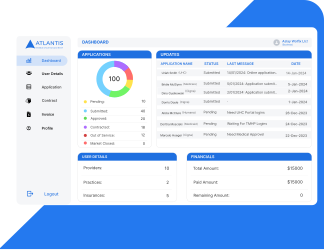
Real-Time Client Report Portal
Access real-time insights into your billing performance with our secure Client Report Portal.Track claims, payments, denials, and KPIs anytime—transparency at your fingertips.
Contact Us