The Ultimate Guide to RCM Solutions (2025 Edition)
How Modern Revenue Cycle Management Solves Real-World Challenges for Healthcare Providers

Introduction
In the ever-evolving world of healthcare, efficiency and financial accuracy are no longer optional—they’re essential. As providers face growing pressure to reduce costs, minimize denials, and improve the patient experience, Revenue Cycle Management (RCM) has taken center stage. This guide explores how modern RCM solutions, backed by automation, real-world provider insights, and industry best practices, are transforming the healthcare landscape.
We’ll dive deep into the pain points voiced by real users, expert insights from seasoned RCM professionals, and data-driven solutions.
What Is Revenue Cycle Management?
Revenue Cycle Management (RCM) is the process healthcare organizations use to track the financial journey of patient care from appointment scheduling to final payment. RCM solutions optimize each step to ensure healthcare providers are paid accurately and promptly for services rendered.
The RCM process typically includes:
- Patient registration and insurance verification
- Medical coding (ICD-10, CPT, HCPCS)
- Charge capture and claims submission
- Payment posting and denial management
- Accounts receivable (AR) follow-up
- Reporting and compliance
- An optimized RCM system ensures:
- Fewer billing errors
- Faster reimbursements
- Stronger compliance
- Better cash flow
Real Pain Points from Healthcare Providers
Across Reddit, Quora, and industry forums, healthcare professionals consistently raise the following pain points:
1. High Denial Rates
Providers frequently cite denied or rejected claims due to:
- Incorrect coding
- Lack of preauthorization
- Eligibility errors
- Missing documentation
2. Delayed Reimbursements
Even clean claims may take 30+ days to process, especially with manual workflows. Delays cause:
- Cash flow issues
- Budgeting problems
- Administrative backlogs
3. Overburdened Staff
Administrative teams are overwhelmed with billing, follow-up, and compliance tasks. As one Reddit user posted:
"Our front desk staff doubles as billers. Mistakes are inevitable."
4. Lack of Transparency
Many practices don’t know where revenue leakage occurs. Without clear KPIs or audit trails, it's difficult to:
- Track claim statuses
- Monitor denials
- Evaluate AR performance
5. Outdated Technology
Many providers still rely on outdated billing software that doesn’t integrate with modern EHRs, leading to:
- Duplicate data entry
- Missed deadlines
- Errors in claim transmission
Expert Insight: What Industry Leaders Say


Core Components of an Effective RCM Solution
Modern RCM platforms go beyond traditional medical billing by combining automation, analytics, and human expertise. Here's what a robust RCM system should include:
1. Eligibility Verification & Preauthorization
- Real-time insurance checks
- Automated triggers for pre-auths
- Patient copay and deductible visibility
- Prevents claim denials before they happen
2. Medical Coding & Charge Capture
- Integrated AI coding suggestions (ICD-10, CPT)
- Built-in compliance checks
- Specialty-specific coding expertise
- Fewer coding errors and faster claim turnaround
3. Claims Management
- Clean claim submission tools
- Payer-specific rules engine
- Automatic rejection detection and fixes
- Improves first-pass acceptance rate
4. Denial Management
- Root cause analysis for recurring issues
- Auto-escalation workflows
- Smart dashboards for denial trends
- Recovers revenue that would otherwise be lost
5. Accounts Receivable (AR) Follow-Up
- Task prioritization by age of claim
- Team performance metrics
- Real-time payer response tracking
- Speeds up reimbursement cycle
6. Reporting & Compliance
- Custom KPI dashboards (e.g., days in AR, denial rate)
- Monthly audit trails
- HIPAA-compliant data storage and handling
In-House vs. Outsourced RCM: What Works Best?

Outsourced RCM providers often offer:
- Certified coding teams
- Access to the latest billing tech
- Performance guarantees
However, a hybrid model is gaining traction. For example, a clinic may handle front-end tasks like eligibility checks internally but outsource coding and AR follow-up to an RCM vendor.
Choosing the Right RCM Partner
Here's how it applies when choosing an RCM partner:
âž” Experience
- Proven track record with practices similar to yours
- Specialty-specific knowledge (e.g., ortho, ENT, pediatrics)
âž” Expertise
- Certified medical coders (CPC, CCS, RHIT)
- Continuous staff training and compliance audits
âž” Authority
- Industry recognition (MGMA, HBMA membership)
- Published whitepapers, speaking at conferences
âž” Trustworthiness
- HIPAA-compliant platforms
- Transparent pricing and reporting
- SLA-backed performance standards
Tip: Ask vendors for performance metrics such as:
- Average denial rate
- First-pass resolution rate
- AR aging analysis
Key KPIs to Monitor RCM Performance
Track these KPIs monthly to measure RCM effectiveness:
- Days in Accounts Receivable (AR): Lower is better (goal: < 35 days)
- Clean Claim Rate: Ideal is > 95%
- Denial Rate: Should be under 5–7%
- Net Collection Rate: Goal is > 96%
- Patient Payment Rate: Increasing trends indicate better financial counseling
- Cost to Collect: Helps measure RCM efficiency and ROI
The Role of AI in Modern RCM Solutions
AI and machine learning are reshaping the RCM landscape:
- Predictive analytics to forecast claim outcomes
- NLP-based coding assistance for faster documentation review
- Automated reminders for unpaid balances and follow-ups
- Fraud detection to flag unusual billing patterns
Practices using AI-enhanced RCM have reported:
- 25–40% reduction in denied claims
- 30% faster reimbursement cycles
- 20% cost savings in billing operations
Case Study: Small Practice, Big Gains
Client: A 3-provider ENT clinic in Austin, TX
Challenge: High denial rates (18%), manual eligibility checks, coding backlogs
Solution: Outsourced RCM with AI-powered eligibility and coding tools
Results after 6 months:
- Denial rate dropped to 5%
- Days in AR reduced from 49 to 29
- Revenue increased by 18%
Common RCM Mistakes to Avoid
- Skipping eligibility checks: Leads to automatic denials
- Undertraining staff: Causes recurring claim errors
- Ignoring denial trends: Misses opportunities for system-wide fixes
- Delaying follow-up: Increases aging AR and write-offs
Conclusion: Future-Proofing Your Revenue Cycle
Revenue Cycle Management is no longer just a back-office task, it's a critical strategy for financial sustainability. With increasing patient volumes, payer complexity, and compliance demands, the need for smart, agile, and tech-enabled RCM solutions has never been greater.
Whether you're a solo provider or part of a multi-specialty group, the right RCM solution will:
- Reduce administrative burden
- Optimize cash flow
- Improve billing accuracy
- Enhance the patient financial experience
Need help optimizing your RCM? Consider a free revenue cycle audit or performance benchmark to identify gaps and growth opportunities.
Our Services


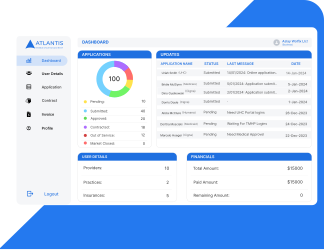
Real-Time Client Report Portal
Access real-time insights into your billing performance with our secure Client Report Portal.Track claims, payments, denials, and KPIs anytime—transparency at your fingertips.
Contact Us