Introduction
Running a family practice involves more than providing routine checkups and treating common health conditions. Physicians and their teams also manage preventive visits, chronic care, immunizations, diagnostic services, insurance verification, medical records, and ongoing patient follow-ups. Behind every completed visit is a billing process that must accurately capture the services provided and support timely reimbursement.
When medical billing becomes difficult to manage, unpaid claims, coding errors, eligibility issues, and delayed payer responses can put pressure on a practice's cash flow. In-house staff may spend hours checking claim statuses and correcting billing issues instead of handling other administrative responsibilities.
This is why many family practices consider working with a specialized medical billing company.
The right billing partner should understand family medicine workflows, payer requirements, documentation standards, and the importance of following claims from submission through final payment. It should also provide clear reporting so practice owners can understand where revenue is being collected, delayed, or lost.
If you are searching for a top family practice medical billing company in the USA, this guide explains the services to look for, common billing challenges, and how to evaluate a partner that fits your practice.
Why Family Practice Medical Billing Requires Specialized Attention
Family medicine practices serve patients across different age groups and manage a wide range of healthcare needs. A single practice may provide annual physicals, sick visits, chronic disease management, vaccinations, preventive screenings, and follow-up appointments.
Each service can involve different documentation, coding, coverage, and payer requirements.
For example, a patient may schedule an annual preventive visit but also discuss a separate medical concern that requires evaluation and treatment. Depending on the services performed, documentation, coding rules, and payer policies, the billing team may need to determine whether additional evaluation and management services can be reported.
The American Medical Association explains the circumstances in which a separately identifiable evaluation and management service may be billed with a preventive visit using modifier 25. The service must meet applicable requirements and be supported by documentation. Practices should review the relevant AMA guidance on preventive and E/M billing.
Other family medicine billing considerations include:
- Correct patient demographics and insurance information
- Accurate CPT, ICD-10-CM, and applicable HCPCS coding
- Preventive care and routine office visit billing
- Medicare annual wellness visits and related requirements
- Chronic condition management services, when applicable
- Immunization and administration coding
- Payer-specific authorization and referral requirements
- Timely claim submission and denial follow-up
Because family practices provide such a broad range of services, their billing partner needs a process that supports both routine claims and more complex billing situations.
Common Medical Billing Challenges for Family Practices
Understanding the most common billing challenges can help practice owners identify where outside support may be useful.
1. Insurance Eligibility and Coverage Issues
A patient may have changed insurance plans, reached a coverage limit, or have benefits that differ from what the front desk expects. If eligibility is not checked correctly, the practice may submit a claim to the wrong payer or discover coverage problems after the visit.
A medical billing team can help verify insurance information, review available benefits, and identify discrepancies before claims are submitted. Eligibility verification does not guarantee payment, but it can help practices identify potential issues earlier.
2. Coding and Documentation Errors
Family practices often bill for a combination of preventive and problem-oriented services. Incorrect code selection, incomplete documentation, missing modifiers, or mismatched diagnosis information can lead to claim rejections, denials, or payment discrepancies.
A qualified billing and coding team should review the information available in the medical record, follow applicable coding guidelines, and flag documentation gaps that require clarification from the provider.
The goal is accurate, supported billing, not simply submitting more codes.
3. Delayed Claims and Unpaid Balances
A submitted claim does not automatically mean payment will arrive promptly. Claims may remain pending because of payer processing delays, missing information, coordination-of-benefits issues, or requests for additional documentation.
Without consistent follow-up, unpaid claims can remain in accounts receivable (A/R) for longer than expected.
An organized billing process tracks outstanding claims, prioritizes follow-up based on age and status, and documents payer responses so the team knows what action is needed next.
4. Repeated Claim Denials
Some denials occur because of missing information or an incorrect claim detail. Others may involve eligibility, coding, authorization, medical necessity, or payer-specific requirements.
Simply resubmitting a denied claim without identifying the cause can lead to repeated problems.
Effective denial management involves reviewing the denial reason, checking the claim and supporting documentation, correcting issues when appropriate, appealing when justified, and identifying patterns that may be prevented in future claims.
5. Limited Visibility Into Financial Performance
A practice may know how much it billed during a month without knowing how much of that amount has actually been collected or how much remains unpaid.
Useful financial reporting should help practice owners understand collections, denial trends, A/R aging, payment delays, and other measures relevant to their operations.
A billing partner should explain these reports in clear language and help the practice identify areas that need attention.
What Should a Family Practice Medical Billing Company Provide?
Not every billing company offers the same scope of work. Before selecting a provider, confirm which services are included in its agreement and which responsibilities remain with your office.
Patient Registration and Insurance Verification
Accurate billing starts with accurate patient information. The billing workflow should account for demographic details, insurance information, subscriber data, and other required claim fields.
Eligibility and benefits verification can help the practice identify coverage concerns before a claim reaches the payer.
Medical Coding and Charge Entry
Coding and charge entry should reflect the services actually provided and documented. The billing team should understand applicable CPT, ICD-10-CM, and HCPCS requirements and recognize when clarification is needed.
Family practices should also ask how the company handles coding questions, documentation gaps, and payer-specific billing policies.
Claims Submission and Tracking
A medical billing company should have a defined process for preparing and submitting claims, monitoring acceptance or rejection, and identifying claims that require correction.
Practices should ask how quickly claims are submitted after receiving complete documentation and how rejected claims are handled.
Denial Management and Appeals
Denial management should go beyond tracking denial totals. The billing team should categorize denial reasons, determine appropriate next steps, correct preventable issues, and pursue appeals when supported by the documentation and payer rules.
Regular reporting can help the practice identify recurring problems and decide whether changes are needed in registration, documentation, coding, or authorization workflows.
Accounts Receivable Follow-Up
A/R management involves monitoring unpaid claims, checking payer status, investigating payment delays, and following up on outstanding balances.
Ask the billing company how it prioritizes aging claims, tracks payer communication, handles underpayments, and reports unresolved accounts.
Payment Posting and Reconciliation
Payments should be posted accurately against the appropriate claims and patient accounts. The process should account for payer payments, adjustments, contractual obligations, and patient responsibility.
Accurate posting supports reliable financial reporting and helps identify discrepancies that may need investigation.
Reporting and Ongoing Communication
Your practice should have access to meaningful billing reports and a clear contact for questions or escalations.
Ask which performance indicators are tracked, how often reports are shared, and whether the billing team schedules regular reviews to discuss trends and outstanding issues.
How to Choose the Right Family Practice Medical Billing Partner
A company may advertise comprehensive billing services, but the best fit for your practice depends on its actual experience, processes, communication, and pricing.
Use these criteria when comparing providers.
1. Family Medicine Experience
Ask whether the company currently supports family medicine or primary care practices. Request examples of the types of services it handles and ask how it approaches preventive visits, office-based E/M services, immunizations, and other common family practice billing situations.
A provider should be able to explain its workflow clearly rather than relying on broad claims about expertise.
2. Understanding of Payer Requirements
Family practices may work with Medicare, Medicaid, Medicare Advantage plans, and commercial insurers. Coverage and claim requirements can vary by payer and service.
Ask how the billing team monitors payer-specific requirements and communicates changes that could affect your practice.
3. Clear Performance Reporting
Before signing an agreement, ask whether the company can report on the following metrics:
- Clean claim rate: The percentage of claims accepted without initial errors or rejections, using the company's stated definition.
- Denial rate: The percentage of claims denied during a defined reporting period.
- Days in A/R: An indicator of how long revenue remains outstanding.
- Net collection rate: A measure of collections against the amount considered collectible under the chosen methodology.
- A/R aging: The value of outstanding balances grouped by how long they have remained unpaid.
Make sure you understand how each metric is calculated. Comparing results is meaningful only when the reporting definitions and time periods are consistent.
4. Compatibility With Your Existing Systems
Your billing partner should understand your current electronic health record (EHR) and practice management system. Discuss access requirements, data exchange, workflow responsibilities, and the transition of open claims.
A clear onboarding plan can help reduce disruption when moving from an in-house team or another billing company.
5. Transparent Pricing
Medical billing companies may charge a percentage of collections, a flat monthly fee, a per-claim rate, or a customized amount based on the work involved.
Ask for a written explanation of:
- Which services are included in the price
- How the billing fee is calculated
- Whether setup or transition fees apply
- Whether credentialing or other services cost extra
- How the contract handles termination and outstanding claims
Compare the total service offering, not just the headline rate.
6. Communication and Accountability
Your practice should know who handles billing questions, denial escalations, payer follow-up, and performance reviews.
Ask about response times, account management, meeting frequency, and how unresolved issues are escalated. Clear responsibilities can help prevent billing tasks from falling between your office and the external team.
Why Consider Atlantis RCM for Family Practice Medical Billing?
Atlantis RCM provides medical billing and revenue cycle management services to healthcare practices across the United States. For family practices evaluating outsourced billing, the company offers support across important parts of the billing process.
Its family medicine billing services cover patient demographic verification, insurance eligibility checks, coding and charge entry, claims processing, payment posting, denial management, A/R follow-up, and financial reporting.
This service scope can be relevant to family practices that want to evaluate support beyond submitting claims. Practices can review their existing workflow, identify where additional billing assistance may be useful, and discuss which responsibilities would be handled by an external team.
When evaluating Atlantis RCM, family practices should discuss their specialty requirements, payer mix, monthly billing volume, current systems, reporting expectations, and any existing claim backlog.
The goal is to establish a service arrangement that fits the practice's actual needs rather than choosing a provider based only on general promises.
What Family Practices Should Discuss With Atlantis RCM
Before moving forward, consider preparing the following information:
- Your practice's specialty mix and number of providers
- The insurance plans and payer types you work with
- Your approximate monthly claim volume
- Current denial patterns and outstanding A/R
- Your EHR and practice management system
- The billing tasks you want to outsource
- The financial reports you need to review regularly
These details can help determine which services are appropriate and what the proposed billing arrangement should include.
Want to evaluate your current billing process? Contact Atlantis RCM to discuss your family practice's needs and ask about a free medical billing audit.
Is Outsourcing Medical Billing Right for Your Family Practice?
Outsourcing is not automatically the best option for every practice. Some practices have an experienced in-house team and well-established billing processes. Others need additional expertise, greater follow-up capacity, or a different way to manage administrative workload.
Outsourcing may be worth evaluating if your practice experiences recurring denials, has a growing backlog of unpaid claims, lacks clear A/R reporting, or spends substantial staff time following up with payers.
Before making a decision, compare the total cost of your current arrangement with the proposed outsourced service. Consider staffing, software, training, oversight, claim follow-up, and the time required to manage billing internally.
Also establish expectations for access to records, reporting, communication, data security, and responsibilities during the transition.
A successful arrangement should give your practice clear visibility into billing performance while keeping appropriate oversight and decision-making in the hands of the practice.
Frequently Asked Questions
What does a family practice medical billing company do?
A family practice medical billing company manages some or all of the administrative processes required to bill health insurers and track reimbursement. Services may include eligibility verification, coding and charge entry, claim submission, payment posting, denial management, A/R follow-up, and reporting.
The exact scope depends on the provider and the contract.
How much does family practice medical billing cost in the USA?
Pricing varies based on claim volume, specialty requirements, payer mix, and the services included. Some providers charge a percentage of collections, while others use flat monthly or per-claim fees.
Request a written quote and confirm whether coding, credentialing, denial follow-up, and other services are included or billed separately.
Can a medical billing company help reduce family practice claim denials?
A billing company may help identify common denial causes, correct claim errors, improve follow-up, and highlight workflow issues that contribute to repeat denials. Results depend on factors such as documentation quality, payer rules, the practice's workflows, and how promptly issues are addressed.
No billing company can guarantee that all claims will be paid or that all denials will be eliminated.
What is the difference between family practice billing and general medical billing?
Family practice billing is a form of medical billing focused on the services and workflows common in family medicine. These may include preventive visits, routine office visits, chronic condition management, immunizations, and care for patients across different age groups.
A general medical billing company may support multiple specialties, so practices should confirm its direct experience with family medicine requirements.
Should a small family practice outsource medical billing?
A small family practice may consider outsourcing when it needs additional billing capacity, more consistent A/R follow-up, support with denials, or a different staffing arrangement. The decision should be based on the practice's workload, budget, reporting needs, and the service level offered by the billing company.
What should I ask before hiring a family practice billing company?
Ask about family medicine experience, payer coverage, services included, coding review processes, denial follow-up, A/R reporting, EHR compatibility, pricing, contract terms, and data security. Request a clear explanation of how the company will communicate with your office and measure performance.
Final Thoughts
Choosing a family practice medical billing company is an important operational decision. The right partner should understand the needs of primary care, manage claims carefully, follow up on unpaid balances, identify recurring denial patterns, and provide reports that help you understand your practice's financial performance.
Before choosing a provider, compare its family medicine experience, service scope, technology compatibility, communication practices, pricing, and contract terms. Make sure the proposed arrangement addresses the specific billing challenges your practice needs to solve.
Atlantis RCM is one option for family practices seeking medical billing and revenue cycle support in the United States. To explore whether its services fit your practice, review Atlantis RCM's family medicine billing services or contact the team to discuss your requirements.
Call: 877-778-3263
Email: [email protected]
Our Services


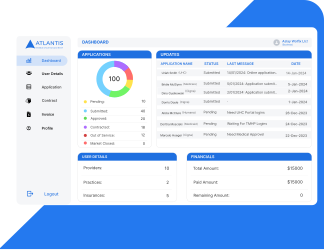
Real-Time Client Report Portal
Access real-time insights into your billing performance with our secure Client Report Portal.Track claims, payments, denials, and KPIs anytime—transparency at your fingertips.
Contact Us