A medical claim can include the correct diagnosis, a documented treatment, and an administered medication, yet still face a payment delay if the drug is reported with the wrong billing code or quantity.
For healthcare providers administering injectable medications, biologics, and other physician-administered drugs, understanding J-codes is an important part of accurate medical billing.
J-codes are HCPCS Level II codes used to identify certain drugs and biological products for healthcare billing. They help payers identify what medication was administered and determine how the drug should be reported on a claim. However, selecting the correct J-code is only one part of the process. Dosage, billing units, medical necessity, documentation, modifiers, coverage rules, and payer requirements can all affect reimbursement. <Cite refs={["turn147556search1","turn456751search3"]}/>
For physician practices, infusion centers, oncology providers, rheumatology clinics, and other organizations that administer medications, even a small coding or unit calculation error can create claim rejections, denials, or underpayments.
This guide explains what J-codes mean in medical billing, how they work, how to calculate billing units, and what providers should review to help prevent avoidable reimbursement issues.
What Are J-Codes?
J-codes are a category of codes within the Healthcare Common Procedure Coding System (HCPCS) Level II. They are commonly used to report certain injectable drugs, infused medications, and biological products administered in clinical settings.
CMS maintains the HCPCS Level II code set, which identifies products, supplies, and services not fully represented by the CPT code set. J-codes are one part of this broader system. <Cite refs={["turn147556search0","turn147556search4"]}/>
A J-code generally identifies a particular drug and specifies a billing unit, such as 1 milligram, 10 milligrams, or another defined quantity. The exact descriptor determines how the medication must be reported.
For example, a code may identify an injection of a specific drug per milligram. The billing team must then calculate how many units correspond to the amount actually administered.
Important: Not every medication uses a J-code, and not every J-code follows the same billing-unit convention. Providers must verify the current code descriptor and applicable payer guidance before submitting a claim.
What Are J-Codes Used for in Medical Billing?
J-codes help healthcare providers report eligible drug products administered during treatment. They are particularly relevant when a medication is supplied and administered by a physician or another qualified healthcare professional.
Depending on the drug, setting, and payer requirements, J-codes may be relevant to:
- Oncology and chemotherapy-related drug billing
- Rheumatology treatments
- Injectable medications administered in physician offices
- Infusion therapy
- Certain biological products
- Other covered physician-administered medications
The appropriate code depends on the exact medication, formulation, dosage, and applicable coding guidance.
J-codes are not a substitute for procedure codes describing the administration service. When separately reportable and payable, the drug and the administration service may require different codes. Whether both are separately reimbursed depends on the payer's payment methodology and applicable coverage rules. <Cite refs={["turn456751search3","turn456751search6"]}/>
J-Codes vs. CPT Codes: What Is the Difference?
J-codes and CPT codes serve different purposes, although both may appear on the same medical claim.
| |||||||||||||||||
|---|---|---|---|---|---|---|---|---|---|---|---|---|---|---|---|---|---|
Each code serves a different purpose. Reporting the correct drug code does not automatically establish that the administration service is separately payable or that the medication is covered.
How Do J-Codes Work?
The J-code billing process involves identifying the medication, selecting the correct code, calculating units, and reporting the service with supporting information.
1. Identify the medication
Confirm the exact drug administered, including its formulation and relevant product details. Similar medications or different formulations should not automatically be treated as interchangeable for billing purposes.
2. Verify the current HCPCS code
Review the current code descriptor and effective date. Codes can be added, revised, or discontinued, so older reference sheets may not reflect the current requirements. CMS publishes HCPCS Level II updates and coding decisions. <Cite refs={["turn147556search0","turn147556search2"]}/>.
Accurate medical coding helps ensure drug codes and billing units match the applicable documentation and coding requirements.
3. Calculate the units
Determine the amount administered and compare it with the dosage specified in the code descriptor.
For example, if a code describes a drug in 1-milligram units and the documented administered dose is 10 milligrams, the basic calculation is 10 billing units, assuming the code descriptor and applicable payer instructions support that calculation.
This is an illustrative example, not a recommendation to use a particular code for a particular drug. Always verify the current descriptor and applicable billing instructions.
4. Review documentation and claim requirements
Confirm that the medical record supports the medication, dosage, route, medical necessity, and other required details. Check applicable modifiers, National Drug Code (NDC) reporting, authorization, and payer-specific requirements.
5. Submit and monitor the claim
After submission, monitor claim acceptance, payer processing, payment, and any denial or documentation request. An accepted claim is not necessarily a paid claim.
What Documentation Is Needed for J-Code Billing?
Drug claims must be supported by documentation appropriate to the medication, service, and payer policy.
Depending on the applicable requirements, the medical record may need to identify:
- Drug name
- Dosage administered
- Route of administration
- Date of service
- Diagnosis and medical necessity
- Administration details when relevant
- Amount administered and amount discarded, where applicable
- Supporting clinical notes and orders
CMS billing guidance for drugs and biologicals identifies documentation such as the drug name, route, and dosage as relevant claim-supporting information. Additional requirements may apply depending on the service and Medicare Administrative Contractor. <Cite refs={["turn456751search0","turn456751search1"]}/>
Documentation should match the drug code and quantity reported. If the record documents one dose but the claim bills another, the inconsistency may trigger a payer review or payment problem.
How Do You Calculate J-Code Billing Units?
One of the most important parts of J-code billing is calculating units correctly.
A J-code descriptor may define a billing unit by milligrams, micrograms, or another dosage measurement. The number of units submitted should reflect the documented amount administered according to the code descriptor and payer instructions.
Basic calculation:
Billing units = Amount administered ÷ Dosage represented by one code unit
For example, if the applicable code represents 5 milligrams per billing unit and the documented dose is 20 milligrams, the calculation would be:
20 mg ÷ 5 mg = 4 units
This example demonstrates the calculation only. Actual claims must follow the exact code descriptor, rounding rules, and payer requirements. Some codes have different conventions, and certain situations require additional guidance.
Common unit-calculation mistakes include:
- Reporting the administered dose as the number of units without checking the descriptor
- Confusing milligrams with milliliters
- Using the medication's concentration instead of the required billing unit
- Billing the entire vial when only part was administered
- Reporting a quantity inconsistent with the medical record
- Using an outdated code descriptor
CMS guidance specifically emphasizes reporting drug units according to the dosage in the applicable HCPCS descriptor. <Cite refs={["turn456751search3","turn456751search11"]}/>
What Are the JW and JZ Modifiers in J-Code Billing?
The JW and JZ modifiers are relevant to certain Medicare Part B drug claims involving single-dose containers or single-use packages.
JW modifier: Reports an eligible amount of drug that was discarded and not administered to the patient, subject to Medicare's applicable requirements.
JZ modifier: Indicates that no drug amount was discarded for applicable separately payable drugs from single-dose containers or single-use packages.
CMS requires the JZ modifier on applicable Medicare Part B claims when no amount was discarded. The JW and JZ rules have specific scope and exceptions, so providers should verify whether they apply to the drug, setting, and claim in question. <Cite refs={["turn456751search2","turn456751search11"]}/>
For a claim involving discarded medication, the medical record should support the amount administered and the amount discarded. The claim must follow the applicable instructions for reporting those amounts.
Do not assume that JW or JZ applies to every drug claim. Packaging, payment status, care setting, and payer policy matter.
Common J-Code Billing Errors That Can Delay Reimbursement
J-code claims can encounter payment problems when the medication, units, documentation, or payer requirements do not match.
Incorrect drug code
Using a code that does not accurately represent the medication or formulation can result in a coding or payment issue.
Incorrect billing units
A claim may report too many or too few units because the billing team misread the descriptor or calculated the dosage incorrectly.
Missing or incorrect documentation
The medical record may not adequately support the drug administered, dosage, medical necessity, or discarded amount.
Incorrect modifier use
A required modifier may be missing, or a modifier may be reported when it does not apply.
Missing NDC information
Some claims require National Drug Code information in addition to the HCPCS code. The required format, unit of measure, and reporting fields depend on the payer and claim type. CMS provides additional guidance for certain unclassified drug claims. <Cite refs={["turn456751search1","turn456751search6"]}/>
Coverage or authorization issues
A correctly coded medication can still be denied if the service does not meet coverage requirements, authorization was required but not obtained, or other plan rules were not satisfied.
Tracking recurring denial reasons and correcting their underlying causes are important parts of effective denial management.
Outdated code information
Using an old code list can result in reporting an incorrect or discontinued code. Billing teams should verify current HCPCS updates rather than relying exclusively on saved spreadsheets or historical claims.
How Can Providers Reduce J-Code Denials?
A reliable J-code billing workflow should include several checks before and after claim submission.
Verify the code. Confirm the current HCPCS descriptor, medication, formulation, and applicable code effective date.
Validate the units. Compare the documented dose with the dosage represented by the code and calculate the correct quantity.
Review the medical record. Ensure the documentation supports the drug, dose, route, date, and medical necessity.
Check modifiers and NDC requirements. Apply the rules relevant to the payer and claim setting.
Confirm coverage and authorization. Check whether the medication is covered, whether prior authorization is required, and whether the service meets plan requirements.
Audit claim patterns. Look for repeated denials, inconsistent units, missing information, and underpayments.
Track unresolved claims. Follow up on rejected and denied claims within applicable deadlines, and determine whether correction, reconsideration, or appeal is appropriate.
A consistent review process can help identify recurring errors before they affect a larger volume of claims.
Reviewing these issues as part of your medical billing process can help identify coding, documentation, and claim-submission errors.
Why J-Code Accuracy Matters for Revenue Cycle Management
J-code billing connects clinical documentation, coding, drug acquisition, claim submission, payment, and denial follow-up. An error in one part of the process can affect the final reimbursement outcome.
For practices administering expensive medications, an incorrect unit calculation or missing documentation can create a meaningful financial impact. Repeated errors can also increase staff workload and outstanding accounts receivable.
This is why J-code review should be part of the broader revenue cycle management process. Coding accuracy, claim quality, payment review, denial follow-up, and A/R monitoring work together to support appropriate reimbursement.
How Atlantis RCM Can Help With Medical Billing and Coding
Drug billing requires attention to code descriptors, dosage units, documentation, modifiers, payer requirements, and claim follow-up. Practices that administer medications may benefit from reviewing these steps as part of their overall billing process.
Atlantis RCM provides medical billing and revenue cycle management services for U.S. healthcare providers. Its support includes medical coding, claims management, denial management, A/R follow-up, and medical billing audits.
For practices experiencing recurring drug-billing denials or unexplained payment differences, a structured review can help identify coding, documentation, and workflow issues that warrant attention.
Request a Free Medical Billing Audit to review potential billing issues and identify opportunities to improve claim accuracy and revenue cycle performance.
Frequently Asked Questions About J-Codes
What does the J stand for in J-codes?
J-codes are a category within HCPCS Level II. The letter identifies the code category; it should not be interpreted as a universal abbreviation for a particular drug or billing method.
Are J-codes only used for injections?
J-codes are commonly associated with certain injectable drugs and biological products, but providers should check the individual code descriptor rather than assume every code describes the same type of medication or administration.
Are J-codes the same as CPT codes?
No. J-codes are HCPCS Level II codes used for certain drugs and biological products. CPT codes generally describe medical procedures and professional services. Both may appear on a claim when applicable.
Does a correct J-code guarantee payment?
No. Payment also depends on coverage, medical necessity, eligibility, documentation, authorization, units, modifiers, contract terms, and payer-specific requirements.
Do all J-codes require the JW or JZ modifier?
No. These modifiers apply to specific circumstances under applicable payer rules. Medicare's JW/JZ requirements have defined scope and exceptions.
Where can providers verify J-codes?
Providers should use the current CMS HCPCS Level II resources and applicable payer or Medicare Administrative Contractor guidance. CMS publishes code updates and coding decisions throughout the year. <Cite refs={["turn147556search0","turn147556search2"]}/>
Final Takeaway
J-codes help healthcare providers report certain drugs and biological products, but accurate billing involves more than choosing a code. The medication, descriptor, dosage units, documentation, modifiers, NDC information, and payer requirements must align.
For practices that administer medications, a consistent review process can help reduce avoidable billing errors, improve denial follow-up, and support appropriate reimbursement.
The goal is simple: report the drug accurately, support the claim with complete documentation, and follow the applicable payer rules from submission through final payment.
Our Services


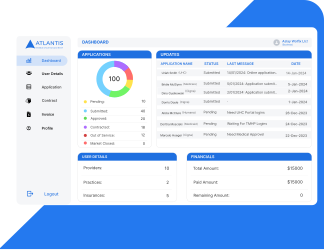
Real-Time Client Report Portal
Access real-time insights into your billing performance with our secure Client Report Portal.Track claims, payments, denials, and KPIs anytime—transparency at your fingertips.
Contact Us