A claim can be medically necessary, correctly coded, and fully documented, yet still come back unpaid because the required prior authorization was missing.
That is where retro authorization may come into play.
Retro authorization, also called retrospective authorization or retroactive authorization, is a request to an insurance payer for approval after a medical service has already been provided.
It can give healthcare providers a path to address certain authorization-related claim denials. But there is an important catch:
Retro authorization is not a guaranteed way to get a denied claim paid.
Whether a payer will consider a retro authorization request depends on the patient's plan, the service, the reason authorization was not obtained, applicable payer rules, and the timeframe for submitting the request.
For medical practices, hospitals, therapy providers, behavioral health organizations, and other healthcare providers, understanding how retro authorization works can help prevent avoidable revenue loss within the medical billing process.
Important: Retro authorization rules vary by payer, plan, state, and service. Providers should verify the applicable payer policy before assuming that a retro request is permitted.
What Is Retro Authorization?
Retro authorization is a request for payer approval after a healthcare service has already been performed.
Under the normal prior authorization process, the provider checks whether authorization is required and obtains the payer's approval before the service takes place.
With retro authorization, that sequence has already been completed incorrectly or could not be followed.
For example:
- A patient's insurance plan requires authorization for a specific procedure.
- The procedure is performed without the required authorization.
- The claim is submitted to the payer.
- The payer denies the claim because authorization was missing.
- The billing or authorization team determines that the payer accepts retro authorization for that situation.
- The provider submits the required clinical and administrative documentation.
- The payer reviews the request.
- If approved, the provider may request claim reprocessing or follow the payer's required next step.
The important point is that retro authorization is a request for approval, not an automatic correction to the claim.
CMS describes prior authorization as a process in which the provider obtains a payer decision before services are rendered. This timing is one of the main differences between prior authorization and retro authorization.
Retro Authorization vs. Prior Authorization
The simplest way to understand the difference is timing.

Prior authorization is designed to address coverage and medical necessity before care is provided. CMS notes that prior authorization allows providers to address potential claim issues earlier in the process.
Retro authorization works in the opposite direction.
Prior authorization prevents the problem. Retro authorization attempts to recover from it.
Why Does Retro Authorization Happen?
There is no single reason a provider may need retro authorization.
Some situations are clinical. Others are administrative.
1. Emergency or Urgent Care
In an emergency, patient care cannot always wait for an authorization decision.
A patient may require immediate treatment, admission, imaging, surgery, or other services before the provider can complete the normal authorization process.
CMS recognizes that prior authorization processes operate differently depending on the service and program, and certain Medicare processes allow care to occur before a subsequent review in specific circumstances.
However, providers should not assume that every emergency automatically qualifies for retro authorization.
The payer's specific policy still matters.
2. Authorization Was Missed
A scheduling, registration, referral, or authorization workflow may fail.
For example:
- The procedure was scheduled before authorization was obtained.
- Staff misunderstood the payer's authorization requirement.
- The authorization request was sent to the wrong payer.
- The authorization expired before the service date.
- The authorization covered a different procedure or location.
- The authorization was approved for the wrong provider.
- A required referral was missing.
- The payer changed during the treatment episode.
These errors can result in authorization-related denials after the service has already been performed.
3. Coverage or Payer Information Was Not Clear
Sometimes the payer information available at the time of scheduling is incomplete or changes unexpectedly.
A patient may have:
- Changed insurance
- Multiple coverage sources
- Newly effective coverage
- A plan change
- An enrollment issue
- Incorrect payer information in the practice management system
If the provider discovers the applicable authorization requirement only after the service, a retro request may be considered if the payer's rules permit it.
4. Administrative or System Errors
Authorization workflows depend on accurate information moving between the provider, payer, EHR, practice management system, and authorization portal.
An authorization may fail because of:
- Incorrect patient information
- Wrong member ID
- Incorrect CPT or HCPCS code
- Incorrect diagnosis information
- Incorrect provider NPI
- Wrong place of service
- Portal submission errors
- Missing documentation
- Payer system issues
The billing team should identify whether the issue is truly an authorization problem before submitting a retro request.
Is Retro Authorization the Same as an Appeal?
No.
This distinction is important.
A retro authorization request asks the payer to review and authorize a service that was already performed.
An appeal challenges a payer decision that has already been made.
For example:
Situation A:
A procedure was performed without required authorization. The payer allows retro authorization. The provider submits a retro authorization request.
That is a retro authorization process.
Situation B:
The payer denies the retro authorization request. The provider believes the payer incorrectly applied its policy and has appeal rights.
That may become an appeal.
The two processes can occur in sequence, but they are not the same thing.
When Will a Payer Approve Retro Authorization?
There is no universal answer.
The payer and plan determine whether retro authorization is available and under what circumstances.
That means a billing team should not rely on a general rule such as "retro auth is allowed within 30 days."
The applicable timeframe and requirements can vary.
Before submitting a request, verify:
- Does the payer permit retro authorization?
- Does the specific plan permit it?
- Does the service qualify?
- What caused the missing authorization?
- What is the submission deadline?
- Is the deadline based on the date of service, denial date, admission date, or another event?
- What documentation is required?
- Does the payer require a specific form or portal?
- Does the payer require a medical necessity explanation?
- What happens after authorization is approved?
- Does the claim need to be corrected or resubmitted?
This payer-specific approach is especially important for organizations working with multiple commercial plans, Medicare Advantage plans, Medicaid managed care plans, and other payer contracts.
What Documentation Is Needed for Retro Authorization?
A payer may require documentation that allows it to determine whether the service met the applicable coverage and medical necessity requirements.
Depending on the payer and service, the request may include:
Patient Information
- Patient name
- Date of birth
- Member ID
- Insurance information
Provider Information
- Provider name
- NPI
- Tax ID
- Facility information
- Rendering provider information
Service Information
- Date of service
- CPT or HCPCS code
- ICD-10-CM diagnosis code
- Place of service
- Number of units
- Requested authorization period
Clinical Documentation
Depending on the service, this may include:
- Physician orders
- Progress notes
- Evaluation reports
- Treatment notes
- Diagnostic reports
- Medical history
- Clinical findings
- Treatment plan
- Referral documentation
- Other supporting medical records
Explanation For the Missing Authorization
This is particularly important.
The provider may need to explain why authorization was not obtained before the service.
For example:
The service was provided during an emergency admission and prior authorization could not reasonably be obtained before treatment.
Or:
The authorization request was submitted, but the payer information available to the provider at the time of scheduling was incorrect.
The explanation should be factual and supported by the record.
What Happens After a Retro Authorization Request Is Submitted?
The payer reviews the request according to its applicable policy.
The process may look like this:
Service provided
↓
Claim submitted
↓
Authorization-related denial identified
↓
Denial reviewed
↓
Payer retro authorization policy verified
↓
Clinical and administrative documentation collected
↓
Retro authorization request submitted
↓
Payer review
↓
Approved or denied
↓
Claim reprocessing, corrected claim, reconsideration, or appeal as applicable
The final step is important.
Obtaining retro authorization does not necessarily mean the claim has already been paid.
The billing team may still need to make sure the authorization information is correctly associated with the claim and follow the payer's instructions for reprocessing.
What Happens If Retro Authorization Is Denied?
A denial does not always mean the revenue recovery process is finished. A structured denial management process can help determine whether the claim should be corrected, reconsidered, appealed, or otherwise escalated.
First, determine why the request was denied.
Common reasons may include:
- Retro authorization is not permitted for the service
- Request was submitted after the payer's deadline
- Clinical documentation did not support medical necessity
- The service was not covered
- The patient was not eligible
- Authorization was required but the circumstances did not qualify for retro review
- Incorrect CPT or HCPCS information was submitted
- Diagnosis information did not support the requested service
- Provider or facility information was incorrect
- Required documentation was missing
- The request was submitted through the wrong channel
The next step depends on the payer's rules.
Possible actions include:
- Correcting missing information
- Requesting reconsideration
- Appealing the denial
- Correcting the claim
- Providing additional clinical documentation
- Reviewing contractual obligations
- Determining whether patient responsibility is appropriate
- Escalating the issue for payer/provider dispute resolution when applicable
Do not automatically transfer the balance to the patient simply because the payer denied the claim.
The provider should first determine what the payer contract, applicable law, plan rules, and circumstances allow.
How Retro Authorization Affects the Revenue Cycle
Retro authorization is not only an authorization issue.
It can affect several parts of the revenue cycle management process.
Delayed reimbursement
The longer an authorization issue remains unresolved, the longer the claim can remain unpaid.
Higher A/R
A denied or suspended claim can increase outstanding accounts receivable (A/R).
More Staff Time
Billing teams may need to coordinate between:
- Front desk
- Scheduling
- Clinical staff
- Authorization specialists
- Coding
- Billing
- Payer representatives
- Patients
- Medical records
Increased Denial Volume
If the same authorization error happens repeatedly, the issue becomes a process problem rather than an isolated claim problem.
Potential Write-Offs
When retro authorization is unavailable or denied and no viable appeal or correction exists, the provider may face an unpaid balance.
This is why retro authorization should be treated as a revenue recovery process, not as a normal billing workflow.
A Simple Example of Retro Authorization
Consider a physical therapy practice.
A patient's health plan requires authorization for a certain number of therapy visits.
The practice verifies eligibility but does not complete the required authorization before the patient's treatment begins.
The patient receives several visits.
The claims are submitted.
The payer denies the claims because the required authorization was not on file.
The billing team reviews the denial and discovers that the payer allows retro authorization under certain circumstances.
The team then:
- Confirms the payer's retro authorization requirements.
- Reviews the patient's coverage.
- Verifies the dates and services involved.
- Checks the CPT codes and units.
- Collects the treatment notes and evaluation.
- Documents why authorization was not obtained.
- Submits the retro authorization request within the applicable timeframe.
- Tracks the payer's decision.
- If approved, follows the payer's instructions for claim reprocessing.
- If denied, evaluates reconsideration or appeal options.
The key lesson is not that every denied claim can be fixed with retro authorization.
The lesson is that the denial should trigger a structured review before the claim is written off or the balance is moved elsewhere.
Retro Authorization for Hospitals and High-Volume Providers
Retro authorization can become especially important for organizations handling large volumes of admissions, procedures, therapy visits, behavioral health services, imaging, or other authorization-sensitive care.
For hospitals and larger organizations, the problem can occur at multiple points:
- Emergency department registration
- Admission
- Observation conversion
- Inpatient stay
- Transfers
- Procedures
- Outpatient services
- Continued stay reviews
- Specialty services
- Discharge planning
A single missed authorization can involve multiple dates of service and substantial reimbursement.
That makes authorization tracking particularly important for organizations with complex payer mixes.
Retro Authorization for Behavioral Health and Therapy Practices
Behavioral health and therapy practices can also encounter authorization-related denials.
Depending on the payer and plan, authorization may be associated with:
- Evaluation services
- Therapy visits
- Intensive outpatient services
- Partial hospitalization
- Applied behavior analysis
- Occupational therapy
- Physical therapy
- Speech therapy
- Substance use treatment
- Extended treatment episodes
For these providers, authorization is often tied to specific service types, units, visit limits, treatment periods, or diagnosis and clinical criteria.
A provider should therefore verify not only whether authorization exists, but also whether the authorization matches the actual service being billed.
How Providers Can Prevent Retro Authorization Problems
The best retro authorization strategy is to need fewer retro requests.
A strong front-end authorization workflow should include:
1. Verify Eligibility
Confirm that coverage is active for the date of service.
2. Check Authorization Requirements
Do not assume that because a patient is eligible, every service is automatically covered without authorization.
Eligibility and authorization are separate questions.
3. Verify The Exact Service
Check the CPT, HCPCS, diagnosis, place of service, provider, units, and treatment dates against the payer's requirements.
4. Track Authorization Expiration
An authorization that was valid last month may not cover today's service.
5. Monitor Authorized Units
A provider may have an approved authorization but exceed the authorized number of visits or units.
6. Match Authorization To The Claim
The authorization number and related information should correspond to the service actually billed.
7. Follow Up on Pending Requests
Do not assume that submitting an authorization request means it has been approved.
8. Audit Recurring Authorization Denials
If the same denial appears repeatedly, investigate the workflow instead of handling every claim separately.
Retro Authorization vs. Authorization Correction
Not every authorization denial requires a retro authorization request.
Sometimes the authorization already exists but the claim contains incorrect information.
For example:
- Wrong authorization number
- Incorrect provider NPI
- Wrong service date
- Incorrect CPT code
- Incorrect place of service
- Units do not match
- Authorization was attached to the wrong provider
In these situations, the correct solution may be claim correction, medical coding review, or payer reconsideration, rather than requesting a completely new retro authorization.
This is why denial analysis should come before action.
First identify what went wrong. Then choose the appropriate recovery path.
Why Documentation Matters in Retro Authorization
Documentation becomes especially important when the payer is reviewing a service after it has already occurred.
The records should support the service that was performed and the reason it was medically appropriate.
For providers, that means documentation should be:
- Complete
- Consistent
- Timely
- Clinically relevant
- Consistent with the billed codes
- Consistent with the diagnosis
- Available for payer review
CMS emphasizes that prior authorization and pre-claim review rely on supporting medical documentation and are intended to identify issues earlier in the payment process.
With retro authorization, the provider is asking the payer to evaluate the service after the fact, so gaps in documentation can become an even bigger obstacle.
Is Retro Authorization a Guarantee of Payment?
No.
This is probably the most important point for providers to remember.
A payer can deny a retro authorization request even when:
- The service was medically necessary
- The patient was eligible
- The provider is participating
- The claim was correctly coded
- The service was actually performed
The payer may still determine that the service does not qualify for retro authorization under the applicable plan rules.
And even when authorization is granted, the claim must still satisfy other payment requirements.
Authorization is not the same thing as payment.
The Bottom Line for Healthcare Providers
Retro authorization can be an important recovery option when required prior authorization was not obtained before a service.
But it should never become the foundation of a practice's authorization strategy.
The strongest approach is to identify authorization requirements before care, verify coverage and service-specific requirements, track authorization status and units, and monitor denials quickly when something goes wrong.
When a retro request is necessary, the billing team should move quickly, verify the payer's exact rules, collect the right documentation, explain why authorization was not obtained, and track the request through final claim resolution.
For healthcare providers, the goal is not to become better at fixing missed authorizations. It is to build a revenue cycle where fewer authorizations are missed in the first place.
Frequently Asked Questions
What is Retro Authorization in Medical Billing?
Retro authorization is a request for insurance approval after a medical service has already been provided. It is sometimes used when prior authorization was not obtained or could not reasonably be obtained before care.
Is Retro Authorization the Same as Prior Authorization?
No. Prior authorization is generally obtained before a service is provided. Retro authorization is requested after the service has already occurred.
Can Every Denied Claim Receive Retro Authorization?
No. Retro authorization depends on the payer, plan, service, circumstances, and applicable submission requirements.
How Long Do You Have to Request Retro Authorization?
There is no universal deadline. Payer and plan requirements can differ, so providers should verify the applicable deadline as soon as an authorization-related denial is identified.
Does Retro Authorization Guarantee Payment?
No. Even if a payer approves retro authorization, the claim must still meet applicable coverage, coding, documentation, eligibility, and payment requirements.
Can Retro Authorization Be Requested After a Claim is Denied?
In some situations, yes. If the payer permits retro authorization for the service and circumstances, the provider may be able to submit a retro request and then follow the payer's process for claim reprocessing or reconsideration.
What Should a Provider Do When a Claim Denies for Missing Authorization?
Start by reviewing the denial reason and verifying whether the payer allows retro authorization. Then check eligibility, authorization requirements, service details, documentation, deadlines, and available reconsideration or appeal options.
How Can Practices Reduce Retro Authorization Requests?
The best approach is to strengthen front-end processes: verify eligibility, check authorization requirements, obtain authorization before care when required, track approved units and dates, monitor pending requests, and review authorization-related denials for recurring workflow problems.
Need Help Identifying Authorization-Related Revenue Leakage?
Atlantis RCM helps healthcare providers manage medical billing and revenue cycle operations, including authorization workflows, claims, denials, A/R, and payment follow-up.
Request a Free Revenue Assessment to identify authorization-related denials, billing issues, A/R delays, and other revenue leakage within your practice.
Our Services


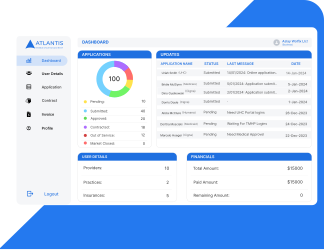
Real-Time Client Report Portal
Access real-time insights into your billing performance with our secure Client Report Portal.Track claims, payments, denials, and KPIs anytime—transparency at your fingertips.
Contact Us