Choosing a medical billing company in 2026 is no longer simply a question of who can submit claims.
Healthcare organizations now have several types of revenue cycle partners to consider. Some provide traditional medical billing and A/R support. Others combine RCM with AI and automation. Some focus heavily on specialty medicine, while others are built primarily for hospitals and large health systems.
That difference matters.
A solo physician practice may need a very different billing partner than a 20-provider specialty group. A hospital may need end-to-end revenue cycle outsourcing, while a growing behavioral health organization may be looking for stronger authorization, coding, denial, and A/R support.
This guide takes a different approach to comparing medical billing companies.
Rather than creating another generic ranking based on marketing claims, we looked at what each company actually focuses on, the organizations it serves, its delivery model, and where its capabilities may fit within the healthcare revenue cycle.
The companies below are not presented as an objective ranking. They represent different approaches to medical billing and healthcare RCM that providers may want to compare in 2026.
The 10 Companies at a Glance
Company | Primary Model | Particularly Relevant To |
| Atlantis RCM | Medical billing + full-cycle RCM | Practices, clinics, physician groups, and healthcare organizations |
| 4D Global | RCM services + staffing + technology | Medical groups and organizations supplementing billing teams |
| Access Healthcare | Technology-enabled RCM | Healthcare organizations looking for automation at scale |
| AGS Health | Technology-enabled RCM + specialized services | Hospitals, health systems, and large healthcare organizations |
| Conifer Health | Enterprise RCM + healthcare financial solutions | Hospitals, health systems, and physician groups |
| Ensemble Health Partners | End-to-end managed RCM | Health systems and large healthcare organizations |
| GeBBS Healthcare Solutions | Technology-enabled RCM + coding | Healthcare organizations with complex coding and revenue workflows |
| Infinx | AI + RCM + patient access | Hospitals, physician groups, and specialty organizations |
Healthcare BPO + RCM Specialty-focused end-to-end RCM | Large healthcare organizations needing scale Specialty medical groups, ASCs, hospitals, and practices |
1. Atlantis RCM
A Full-Service Option for U.S. Healthcare Providers
Atlantis RCM takes a broader approach to healthcare revenue cycle support than claim submission alone.
Atlantis RCM provides medical billing and revenue cycle management alongside medical coding, credentialing, prior authorization, claims and denial management, A/R management, practice management, patient support, virtual medical assistant services, and medical billing audits. This makes the company relevant to healthcare organizations looking to outsource one or multiple revenue-cycle functions rather than manage every process internally.
Atlantis RCM states that it supports healthcare providers across the United States and has expertise across 30+ medical specialties.
Why Providers Consider Atlantis RCM
The important distinction is that Atlantis RCM's offering extends across different stages of the revenue cycle.
Its published RCM process includes patient registration, insurance verification, prior authorization, coding, charge entry, claim generation and submission, claim tracking, denial management, A/R follow-up, and patient statements.
Providers can also choose between full-cycle RCM and specific components such as billing, coding, or claims management, according to Atlantis RCM's FAQ.
Who May Consider Atlantis RCM?
This makes Atlantis RCM potentially relevant to:
- Independent physicians and small practices
- Multi-specialty medical groups
- Clinics and ambulatory organizations
- Behavioral health and mental health practices
- Specialty practices
- Multi-location healthcare organizations
- Hospitals and larger healthcare organizations
The company's current website specifically positions its services for healthcare practices of different sizes and highlights nationwide specialty support.
A Practical Starting Point for Providers
Rather than immediately changing billing companies, a practice can first assess where its current revenue cycle is losing money.
Atlantis RCM offers a free medical billing performance audit that it says examines areas such as denial patterns, coding gaps, A/R performance, and potential revenue opportunities.
2. 4D Global
A Consideration for Practices Supplementing Their Billing Operations
4D Global takes a somewhat different approach by combining revenue cycle services with staffing and technology.
Its published RCM services include patient demographic and charge entry, coding, payment posting, denial management, A/R follow-up, provider credentialing, credit balance resolution, and eligibility and benefits verification.
The company says it serves medical groups as well as billing and software companies.
This model may be worth comparing for practices that already have an internal billing operation but need additional capacity.
For example, a practice might want external support specifically for:
- A/R follow-up
- Coding
- Denial work
- Payment posting
- Eligibility verification
- Credentialing
Rather than replacing its entire billing department, an organization can evaluate whether supplemental external resources make more sense.
What to Ask
If considering a staffing-plus-RCM model, ask:
- Which functions remain with the practice?
- Who supervises the external team?
- How is work quality measured?
- What reporting is provided?
- Are resources dedicated or shared?
- How are sensitive healthcare data and access controlled?
3. Access Healthcare
A Technology-Enabled RCM Model
Access Healthcare combines revenue cycle expertise with automation, analytics, and technology.
The company describes its model as technology-enabled RCM covering areas from patient access through A/R management. It also promotes AI-embedded revenue cycle services and automation.
This makes Access Healthcare particularly relevant to organizations that are evaluating more than conventional outsourced billing.
Instead of viewing RCM simply as labor, the model emphasizes:
- Automation
- Analytics
- Revenue-cycle workflows
- Patient access
- A/R management
- Technology-supported operations
- Human oversight
For larger organizations, the question becomes less about whether to outsource billing and more about how much of the revenue cycle should be automated, managed externally, or retained internally.
What to Ask
Providers evaluating a technology-heavy RCM model should ask:
- Which workflows are automated?
- Which activities still require human review?
- How are exceptions handled?
- How does the system integrate with the existing EHR?
- What data can administrators access?
- How is automation performance monitored?
4. AGS Health
A Revenue Cycle Partner for Larger Healthcare Operations
AGS Health describes itself as a technology-enabled revenue cycle management company combining AI-enhanced technology, data-driven services, and specialized support.
Its current website highlights substantial operational scale, including billions of dollars in A/R processed annually and millions of charts coded.
AGS also publishes educational material describing RCM as a process extending from the first patient interaction through final payment collection, with areas such as eligibility, documentation, coding, denials, and reimbursement affecting financial performance.
That makes AGS particularly relevant when an organization is evaluating a larger-scale, technology-supported RCM operation.
Where It May Fit
Organizations considering this type of provider may include:
- Hospitals
- Health systems
- Large physician organizations
- Healthcare organizations with high claim volumes
- Organizations looking for technology-enabled revenue-cycle operations
The Important Comparison
Large-scale RCM does not automatically mean it is the right operational fit for every practice.
A smaller practice should determine whether the vendor's implementation model, account management structure, minimum requirements, and pricing make sense for its size.
5. Conifer Health
Designed Around Hospitals, Health Systems, and Larger Healthcare Organizations
Conifer Health operates at a different end of the market from many physician-focused billing companies.
Its current website identifies hospitals, health systems, physician groups, and employers and unions among the organizations it serves. Its revenue management solutions include A/R management, claims-related work, payer understanding, and patient financial processes.
The company's current revenue-management material also highlights work around:
- A/R management
- Claims submission
- Denial reduction
- Payer processes
- Self-pay
- Patient financial experience
This is important because hospital and health-system RCM often involves considerably more complexity than professional-fee billing for a small physician office.
When to Compare a Provider Like Conifer
A hospital or health system may need:
- Large-scale A/R management
- Patient access support
- Payer strategy
- Enterprise revenue-cycle operations
- Financial clearance
- Complex reimbursement workflows
A small practice should not assume an enterprise RCM model is automatically appropriate simply because the company has significant scale.
6. Ensemble Health Partners
For Organizations Considering End-to-End RCM Outsourcing
Ensemble Health Partners is heavily focused on end-to-end revenue cycle management for healthcare organizations.
Its current offering spans patient engagement, revenue capture, reimbursement, payer strategy, reporting, and EHR optimization.
The company says it manages end-to-end revenue cycle operations for more than 200 hospitals nationwide.
Ensemble has also received a 2026 Best in KLAS designation for end-to-end revenue cycle outsourcing, with a reported score of 96.9/100.
That is a documented industry recognition, rather than an independent conclusion that it is universally the best option.
What Makes Its Model Notable
Ensemble's published scope includes:
- Patient engagement
- Scheduling and registration
- Financial clearance
- Authorization
- Coding
- Charge validation
- Billing
- Insurance collections
- Patient collections
- Denial recovery
- Underpayment recovery
- Payer performance reporting
- Epic optimization
For hospitals and health systems considering full revenue-cycle outsourcing, this is a different proposition from hiring a conventional medical billing company.
What Providers Should Examine
Before moving to an end-to-end model, determine:
- Which internal positions would change?
- How will implementation be handled?
- Which KPIs will determine success?
- What systems will the vendor use?
- How much control will remain with the healthcare organization?
- What happens to existing A/R?
7. GeBBS Healthcare Solutions
A Combination of RCM, Coding, and Healthcare Technology
GeBBS Healthcare Solutions provides technology-enabled RCM combining AI and experienced revenue-cycle professionals.
Its current website describes capabilities across patient access, coding, billing, denials, and A/R.
The company also has specialized RCM offerings for areas such as DME and HME.
Its DME/HME materials address workflows involving documentation, eligibility, order delays, denials, and A/R.
This can make GeBBS particularly relevant for organizations where coding, documentation, and revenue-cycle operations are closely connected.
A Useful Comparison Point
For specialty organizations, ask whether the billing company understands the clinical and documentation requirements behind the claim.
A vendor that understands only the financial transaction may not provide the same value as one with deeper knowledge of the specialty's coding and documentation environment.
8. Infinx
For Providers Looking at AI, Patient Access, and RCM Together
Infinx represents another evolution of the RCM model.
The company combines AI agents, automation, and RCM specialists across patient access and revenue-cycle workflows. Its current offering includes authorization, coding, billing, A/R, denial follow-up, analytics, and integrations with healthcare systems.
Infinx says it supports hospitals, health systems, and physician groups and lists specialties including radiology, cardiology, orthopedics, physical therapy, behavioral health, gastroenterology, oncology, ophthalmology, urology, and others.
Why This Matters
Many revenue-cycle issues begin before a claim is submitted.
For example:
Patient access → eligibility → authorization → documentation → coding → claim → payment → denial → A/R
A problem early in that chain can create work later.
Infinx's model attempts to connect those workflows using automation and human intervention when exceptions require review.
What to Ask
If AI-enabled RCM is being considered, providers should ask:
- What decisions does the AI make?
- What requires human review?
- How are exceptions routed?
- How is coding accuracy monitored?
- How does the system integrate with the existing EHR?
- What happens when payer rules change?
9. Omega Healthcare
A Large-Scale Healthcare BPO and RCM Option
Omega Healthcare is another major healthcare outsourcing organization that appears in current 2026 healthcare RCM market coverage.
Current industry listings describe Omega as providing RCM, coding, clinical documentation improvement, A/R management, and analytics at large scale.
This type of organization may be more relevant to larger healthcare operations that need substantial workforce capacity across multiple healthcare administrative functions.
Where Scale Can Matter
Large healthcare organizations may need:
- High-volume coding
- Revenue-cycle operations
- A/R management
- Documentation support
- Analytics
- Back-office staffing
- Multi-specialty capabilities
However, scale should be evaluated alongside account management and operational fit.
A large vendor can have extensive resources while still requiring a careful assessment of how your individual organization will be supported.
10. Coronis Health
A Specialty-Focused RCM Model
Coronis Health stands out because its current positioning centers heavily on specialty medicine.
The company describes its model as end-to-end RCM for specialty medical groups, covering provider enrollment through revenue recovery.
Its published capabilities include:
- Eligibility verification
- Prior authorization
- Registration quality assurance
- Claim edits
- Denial prevention
- Clinical appeals
- Root-cause analysis
- A/R follow-up
- Denial management
- Underpayment recovery
- Payment posting
- Legacy A/R cleanup
Coronis currently states that it manages more than $20 billion in collections annually and has more than 40 years of RCM experience.
Its public case studies also cover organizations such as emergency medical services and hospitals.
Why Specialty Depth Matters
A cardiology practice, anesthesia group, behavioral health organization, DME company, and primary care practice can have very different billing workflows.
Specialty experience can therefore be an important factor when comparing vendors.
The Bigger Question: What Kind of Billing Partner Does Your Organization Need?
The 10 companies above illustrate an important point.
There is no single type of medical billing company.
There are at least four broad models providers can encounter.
1. Traditional Outsourced Medical Billing
This model typically focuses on:
- Claims
- Coding
- Payment posting
- Denials
- A/R
- Patient billing
It can make sense for practices that already have their clinical and administrative workflows established but need external billing support.
2. Full-Cycle RCM Outsourcing
This goes beyond billing and may include:
- Patient access
- Eligibility
- Authorization
- Coding
- Claims
- Payment posting
- Denials
- A/R
- Patient collections
- Reporting
This model may be more relevant to organizations looking to outsource a significant portion of their revenue cycle.
3. Technology-Enabled RCM
These providers combine human RCM teams with:
- AI
- Automation
- Analytics
- Workflow systems
- Predictive tools
- EHR integrations
This model is increasingly relevant in 2026 as healthcare organizations look for ways to handle growing administrative complexity without relying entirely on manual processes.
4. Specialty-Focused RCM
Some organizations focus heavily on specific specialties or healthcare segments.
That can matter when billing involves:
- Complex CPT coding
- Prior authorization
- Specialty documentation
- High-dollar claims
- Unique payer rules
- Facility-specific workflows
- Specialty-specific denial patterns
What Should Healthcare Providers Compare Before Signing a Contract?
Rather than asking which company is “the best,” compare the areas that will directly affect your organization.
Service Scope
Determine exactly what is included.
Does the proposal cover:
- Medical billing?
- Coding?
- Claims?
- Denials?
- A/R?
- Credentialing?
- Prior authorization?
- Eligibility?
- Payment posting?
- Patient billing?
- Reporting?
Do not assume that “full-service RCM” means the same thing from every company.
Specialty Experience
Ask for examples of organizations similar to yours.
A vendor may have extensive healthcare experience but limited experience with your specific specialty.
Ask:
“How many providers in my specialty do you currently support?”
That question can reveal more than a generic list of specialties on a website.
EHR and PMS Compatibility
Confirm whether the company already works with your technology.
Depending on your organization, this may include systems such as:
- Epic
- eClinicalWorks
- athenahealth
- Cerner
- Kareo
- Tebra
- AdvancedMD
- Other specialty-specific platforms
Ask whether the vendor works inside your current system or expects you to migrate to another platform.
Denial Management
Do not settle for:
We Handle Denials.
Ask how.
- A useful evaluation should cover:
- How are denials categorized?
- Who identifies the root cause?
- Who submits appeals?
- How are recurring payer issues identified?
- How quickly are denied claims worked?
- How are results reported?
A/R Management
Ask what happens to unpaid claims after 30, 60, 90, and 120 days.
You should understand:
- A/R aging methodology
- Payer follow-up
- Patient balance follow-up
- High-dollar claim escalation
- Appeal processes
- Legacy A/R cleanup
- Reporting
What Questions Should You Ask During a Billing Company Demo?
Before signing anything, ask these questions directly.
Who will actually work my accounts?
You want to understand the team structure, not just the sales presentation.
How often will I receive reports?
Find out whether reporting is monthly, weekly, real-time, or available through a dashboard.
What happens to my existing A/R?
This is especially important when switching billing vendors.
How do you measure denial performance?
Ask whether the vendor tracks denial rate, denial dollars, root causes, appeals, and recovery.
What is included in the fee?
Get every service and additional charge in writing.
What happens if we want to leave?
Review contract length, termination terms, data access, outstanding A/R, and transition procedures.
Can you provide references from practices like ours?
A reference from a similar specialty and organization size is more useful than a generic testimonial.
What About Pricing?
Medical billing pricing can vary significantly based on:
- Specialty
- Claim volume
- Provider count
- Service scope
- Percentage-of-collections model
- Flat-fee arrangements
- Coding requirements
- A/R workload
- Credentialing
- Patient billing
- Technology requirements
That is why comparing companies solely by percentage is risky.
For example, a 3% proposal that covers only claim submission is not directly comparable with a 6% proposal covering billing, coding, denials, A/R, credentialing, authorization, payment posting, and reporting.
The real question is:
What are you receiving for the fee, and what financial and administrative work will remain with your organization?
Should You Outsource Your Entire Revenue Cycle?
Not necessarily.
Some healthcare organizations outsource nearly everything.
Others keep certain functions internally while outsourcing specific areas such as:
- Coding
- A/R
- Denial management
- Credentialing
- Prior authorization
- Payment posting
- Medical billing
A hybrid model can sometimes make more sense than a complete transition.
The right structure depends on your staffing, specialty, technology, claim volume, internal expertise, and revenue-cycle goals.
Where Does Atlantis RCM Fit?
Atlantis RCM is one of the companies healthcare providers can compare when they want a broader medical billing and RCM relationship.
Its published service portfolio covers medical billing, RCM, coding, claims, denials, A/R, credentialing, prior authorization, practice management, patient help desk support, virtual medical assistants, and medical billing audits.
That gives providers the option to evaluate Atlantis RCM for either broader revenue-cycle support or selected services.
The company's current materials also state that it serves healthcare providers nationwide and supports more than 30 specialties.
For a practice considering a billing change, the most useful starting point may not be a sales pitch.
It may be an assessment of what is happening with the practice's billing today.
Consider a Free Medical Billing Audit
A medical billing audit can help identify areas such as:
- Claim denials
- Coding gaps
- Aging A/R
- Payment issues
- Eligibility problems
- Revenue leakage
- Billing workflow gaps
Atlantis RCM currently promotes a free medical billing audit as a way to assess revenue-cycle performance and identify potential areas for improvement.
Request a Free Medical Billing Audit
Final Takeaway
The medical billing market in 2026 is not one-size-fits-all.
A small physician practice may need a responsive billing team.
A multi-specialty group may need deeper coding and A/R capabilities.
A specialty practice may benefit from a vendor with specific payer and workflow experience.
A hospital or health system may need end-to-end RCM management, enterprise integrations, patient access support, and large-scale revenue operations.
And an organization focused on modernization may place greater weight on AI, automation, analytics, and system integration.
So instead of asking:
“Which medical billing company is the best?”
A more useful question is:
“Which billing and RCM model fits the way our organization operates?”
Start with your specialty, provider count, claim volume, payer mix, current A/R, denial patterns, EHR/PMS, internal billing resources, and the amount of the revenue cycle you actually want to outsource.
Then compare vendors against those requirements.
That approach gives healthcare providers, practices, clinics, and hospitals a much clearer basis for choosing a medical billing partner in 2026.
Our Services


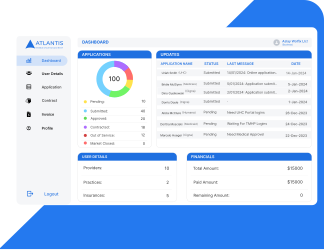
Real-Time Client Report Portal
Access real-time insights into your billing performance with our secure Client Report Portal.Track claims, payments, denials, and KPIs anytime—transparency at your fingertips.
Contact Us