Grow Therapy Reimbursement Rates for Therapists in 2025–2026

Understanding Grow Therapy reimbursement rates is essential for any therapist considering joining the platform. This guide breaks down payouts, CPT code reimbursement, and state-specific trends. You will learn how factors like licensure, insurance, and session type impact your earnings.
If you want to streamline your medical billing processes, Atlantis RCM can help optimize your claims efficiently.
What Grow Therapy Offers to Providers
Grow Therapy connects licensed therapists with clients for in-person and telehealth sessions. Providers can set schedules, select clients based on insurance, specialty, and location, and focus on therapy while Grow handles administrative tasks.
The platform does not charge subscription fees. Instead, it takes a percentage of insurance payouts, then deposits payments directly to providers after claims are processed.
Services include insurance verification, claim creation, submission, and tracking. This reduces the need for complex medical coding and allows providers to concentrate on clinical work.
For therapists seeking support in billing and credentialing, Atlantis RCM can assist with Medicare credentialing and claims management.
How Grow Therapy Pays Providers
Grow Therapy uses an independent contractor model. Your reimbursement depends on:
Provider licensure
CPT code and session length
Insurance type and coverage
State and city
The platform does not publish a universal rate chart. Providers access estimated payouts through the Grow Therapy Provider Portal and personalized rate sheets.
Grow Therapy payouts vary by location and payor type. Market demand, cost-of-living, Medicare locality adjustments, and insurance negotiations all influence final amounts.
Typical Provider-Reported Rates
Based on provider reports and in-network trends, average therapist reimbursement rates are:
Diagnostic intake (90791): 100–160 per session
Individual psychotherapy 45–50 min (90834): 70–100 per session
Individual psychotherapy 60 min (90837): 80–120 per session
Individual psychotherapy 30 min (90832): 60–90 per session
Crisis psychotherapy (90839): 90–140 per session
Exact amounts vary by state and insurance plan. Providers should always check their portal and payor agreements for confirmation.
State-by-State Reimbursement Trends
Higher Benchmark States
Alaska, New York, New Jersey, Massachusetts, Connecticut, California coastal metros, Washington, Virginia, Colorado, Washington D.C.
Typical reimbursement for a 60-minute session: 100–140
Benefits: strong commercial fee schedules, high Medicare locality adjustments, dense urban client base
Midpoint Range States
Texas, Florida, Illinois, Minnesota, Michigan, Georgia, North Carolina, Wisconsin
Average reimbursement: 80–110
Features: stable commercial payer rates, moderate cost-of-living, high client availability
Lower Benchmark States
Arkansas, Alabama, Mississippi, Oklahoma, Iowa, Kansas, rural Maine, rural Pennsylvania
Typical reimbursement: 60–85
Challenges: lower Medicaid and Medicare reimbursements, fewer commercial payers
For professional support in navigating state-specific reimbursement trends, Contact Atlantis RCM !
Comparing Grow Therapy with Traditional Contracting
Traditional insurance contracts often require long credentialing, extensive paperwork, and slow payments. Claims can take up to 21 business days to process.
Grow Therapy provides:
Faster payouts, usually 7 days after insurance payment
Direct claim submission and monitoring
Payment protection for in-network claims
However, providers do not control fee splits or have full transparency on insurer-to-provider payouts.
How Grow Therapy Handles Claims and Payments
Once a provider submits an invoice, Grow Therapy:
Creates and submits insurance claims
Manages patient cost-sharing (copays/deductibles)
Issues weekly payouts via Stripe deposit (typically received by Monday)
Invoices must be submitted within 14 days to avoid delays or reductions in payouts.
Factors Affecting Provider Reimbursement
Earnings depend on:
Licensure level
Regional market rates
Client insurance mix
Chosen CPT codes and session length
Documentation accuracy
No-shows and cash-pay policies
Frequency of extended or crisis sessions
Intake codes and crisis codes generally yield the highest reimbursement.
Requesting a Grow Therapy Rate Sheet
Providers can access customized rate sheets via the Grow Therapy portal. Rate sheets display payor-specific reimbursement ranges per CPT code and help project revenue.
Keep your sheets updated, as payor agreements change over time. For further assistance in medical billing and CPT optimization.
Atlantis RCM provides expert guidance. Book an Audit now!
Maximizing Grow Therapy Reimbursement
Tips to increase earnings:
Review rate sheets and optimize caseloads based on high-paying CPT codes
Submit invoices before deadlines
Document sessions immediately to avoid expired invoices
Implement no-show and cash-pay policies
Use accurate CPT coding and documentation
Monitor payout reports for discrepancies
When Grow Therapy May Not Be Ideal
Grow Therapy may not fit providers who:
Have strong private insurance contracts
Offer niche services not covered by standard codes
Prefer full control over EHR, billing, and clients
Want to avoid platform fee splits
Many clinicians use Grow Therapy temporarily for medical credentialing and initial caseload building before transitioning to private contracts.
Conclusion
Grow Therapy reimbursement rates for 2025–2026 are competitive with national averages. Most clinicians earn between 60 and 150 per session, depending on CPT code and market.
The platform simplifies claims, provides faster payouts, and reduces administrative burden. Combined with professional support from Atlantis RCM, therapists can optimize insurance reimbursement for therapy, streamline medical coding, and increase overall earnings.
FAQs
1. What are Grow Therapy reimbursement rates?
Ans: Grow Therapy reimbursement rates vary by CPT code, provider licensure, and location, ranging from 60 to 160 per session.2. How does Grow Therapy pay providers?
Ans: Providers receive payouts directly via bank deposit after insurance claims are processed, usually within 7 days after payment.3. Which states have the highest reimbursement rates?
Ans: Alaska, New York, New Jersey, Massachusetts, Connecticut, California coastal metros, Washington, Virginia, Colorado, and D.C.4. Can I negotiate Grow Therapy payment rates?
Ans: No, rates are determined by insurance contracts, provider licensure, and location. Providers can request a rate sheet to review their payouts.5. How can therapists maximize earnings?
Ans: Optimize CPT codes, submit invoices on time, reduce no-shows, and monitor payouts regularly.6. Does Grow Therapy handle billing and claims?
Ans: Yes, Grow Therapy manages insurance verification, claim creation, submission, and tracking for providers.7. When is Grow Therapy not ideal?
Ans: It may not suit providers with high private insurance contracts, niche services, or those seeking full EHR and billing control.Our Services


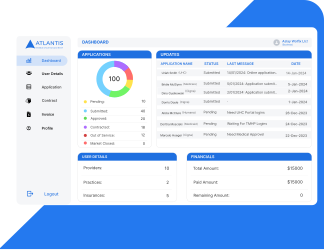
Real-Time Client Report Portal
Access real-time insights into your billing performance with our secure Client Report Portal.Track claims, payments, denials, and KPIs anytime—transparency at your fingertips.
Contact Us