HIPAA Compliance in Medical Billing: A Complete Guide

HIPAA Compliance in Medical Billing is more than a regulatory requirement; it’s a commitment to protecting patient trust, maintaining data integrity, and ensuring your healthcare organization operates within the highest ethical standards. For healthcare providers, billing teams, and RCM professionals, compliance with the Health Insurance Portability and Accountability Act (HIPAA) is essential to avoid financial penalties, reputational harm, and operational disruptions.
At Atlantis RCM, we help medical practices implement comprehensive end-to-end compliance strategies that align with federal regulations, while optimizing their revenue cycle management performance.
What Is HIPAA and Why Is It Important in Medical Billing?
HIPAA, enacted in 1996, ensures the confidentiality, integrity, and security of Protected Health Information (PHI) and Electronic Protected Health Information (ePHI). In medical billing, compliance involves secure handling of patient data from claim submission to reimbursement.
Healthcare providers must establish administrative, technical, and physical safeguards to protect PHI during every stage of billing. Non-compliance not only results in costly HIPAA violations and penalties but also damages patient confidence in your organization.
In-House Medical Billing and HIPAA Compliance
Large healthcare practices often use in-house billing teams under their direct supervision. Since these teams work for the covered entity, they are not considered separate business associates under HIPAA. This model accelerates the billing process by providing direct access to physicians for clarifications on diagnoses or treatments.
Despite these advantages, in-house teams must maintain strict HIPAA compliance. Implementing secure communication systems, following the Minimum Necessary Standard, and restricting access to PHI are essential for ensuring patient data remains protected.
Outsourced Medical Billing and HIPAA Compliance
Smaller practices often outsource medical billing to reduce costs. In such cases, third-party billing companies handle claims on behalf of the healthcare provider (the Covered Entity). These third parties are considered Business Associates under HIPAA, as they access PHI to process billing operations.
Before sharing PHI, a Business Associate Agreement (BAA) must be signed between the provider and medical billing company. This contract outlines each party’s responsibility in maintaining HIPAA compliance, ensuring PHI is handled securely throughout the billing cycle.

HIPAA Privacy Rule
The HIPAA Privacy Rule governs how healthcare providers collect, use, and disclose PHI. It grants patients the right to access, view, and control their medical information. Healthcare providers must obtain written consent before sharing PHI with insurance companies or other medical professionals.
Failure to comply can result in severe penalties.
For example: The University of Texas MD Anderson Cancer Center faced a $4.3 million fine in 2018 for exposing patient data due to insufficient privacy safeguards. This case underscores the importance of strict compliance with the Privacy Rule to protect patient confidentiality.
HIPAA Security Rule
The HIPAA Security Rule focuses on protecting electronic PHI (ePHI) by implementing administrative, physical, and technical safeguards. These include encryption, access controls, and disaster recovery plans. Healthcare providers must ensure that only authorized individuals can access sensitive patient data.
Regular employee training, security policy reviews, and risk assessments are crucial components of HIPAA compliance. By proactively identifying vulnerabilities, healthcare providers can mitigate potential breaches before they occur.
For example: Atlantis RCM integrates HIPAA-compliant billing software that uses encryption and role-based access to prevent unauthorized data exposure.
HIPAA Privacy Rule vs HIPAA Security Rule
While both rules aim to protect patient data, their focus differs. The Privacy Rule governs the use and disclosure of PHI across all formats oral, written, and electronic while the Security Rule applies specifically to electronic PHI.

How Long Does HIPAA Compliance Last?
Under the HIPAA Security Rule, all records containing PHI must be securely stored for at least six years. However, retention requirements vary by state and federal laws. For instance, CMS mandates hospitals to retain records for at least six years, while critical access hospitals must do so for five.
Some organizations must comply with OSHA’s 30-year retention rule for employee medical records, depending on the nature of the data handled.
HIPAA Compliance for Healthcare Providers
Healthcare providers should establish internal policies specific to their operations. These include defining access roles, monitoring system activity, and maintaining documentation of compliance efforts.
Using encrypted emails, secure file transfers, and permission-based access helps prevent unauthorized data exposure. Providers must regularly update their cybersecurity systems to address new threats.
Controlling facility access, securing workstations, and protecting devices containing PHI are crucial for physical data protection. Regular audits ensure compliance gaps are detected and resolved quickly.
Penalties for HIPAA Violations
Violating HIPAA can result in severe civil and criminal penalties. The Office for Civil Rights (OCR) enforces HIPAA regulations, imposing fines ranging from $100 to $50,000 per violation, with an annual cap of $1.5 million. In extreme cases, criminal violations can lead to fines of up to $250,000 and imprisonment for up to 10 years.
These penalties highlight the importance of maintaining robust HIPAA compliance in medical billing practices to safeguard patient data and avoid costly repercussions.
Conclusion
HIPAA compliance in medical billing is vital for protecting patient data, avoiding penalties, and maintaining trust. By ensuring secure data handling, regular audits, and staff training, healthcare providers can stay compliant and confident in their operations.
Partner with Atlantis RCM for reliable, HIPAA-compliant medical billing solutions that protect your practice and enhance revenue performance.
👉 Contact Atlantis RCM today to simplify compliance and strengthen your medical billing process.
Our Services


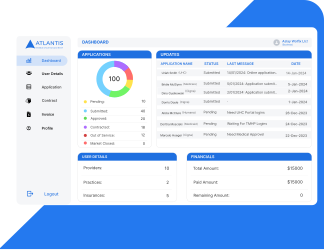
Real-Time Client Report Portal
Access real-time insights into your billing performance with our secure Client Report Portal.Track claims, payments, denials, and KPIs anytime—transparency at your fingertips.
Contact Us