How to Bill DME Claims to Medicare

Billing DME Medicare Claims is a complex process that requires accuracy, compliance, and attention to detail. For durable medical equipment (DME) suppliers, errors in documentation, coding, or claims can cause costly denials and delays. This guide helps providers send Medicare claims correctly, avoid mistakes, and get paid on time.

Step 1: Verify Eligibility and Enrollment
The first step is confirming that the patient has active Medicare Part B coverage. Medicare Part B covers DMEPOS (durable medical equipment, prosthetics, orthotics, and supplies) when medically needed at home.
Providers must also check that they are Medicare enrolled and active as a certified supplier. Without enrollment, Medicare will not issue reimbursement. Suppliers must have a PTAN, an NPI, and meet rules from the Centers for Medicare & Medicaid Services (CMS).
Example: Under Part A, a skilled nursing facility cannot bill separately for a patient’s DME. Once discharged, billing can begin under Part B rules.
Step 2: Gather Documentation
Accurate documentation is essential for smooth claims processing. Every claim must be supported by:
Standard Written Order (SWO): Includes patient name, Medicare ID, item description, HCPCS code, quantity, provider NPI, and signature.
Medical records: Show medical necessity and physician notes.
Proof of Delivery: Signed documentation or shipping record confirming delivery.
Advance Beneficiary Notice (ABN): Used when it’s not clear if Medicare will pay, so the patient knows they might have to pay.
Medicare contractors reject claims when records are missing or incomplete.
Step 3: Apply Correct HCPCS Codes and Modifiers
A HCPCS code identifies what is billed for every item. Claims also need: NU for new, RR for rented, and KX if rules are met.
If the wrong code or modifier is used, the claim will be denied. For example, oxygen concentrators need the rental code and the KX modifier to show the patient qualifies for coverage.
Pro Tip: Do not confuse HCPCS with CPT codes, which describe procedures and services instead of equipment.
Step 4: Complete the CMS-1500 or 837P Claim Form
Providers must file claims using the CMS-1500 paper form or its electronic equivalent, the 837P. Each field must be accurate to avoid denial. Critical fields include:
Patient and provider identifiers
Diagnosis pointers linking ICD-10 codes to the service line
Correct place of service code (e.g., 12 for home)
Prior authorization number if required
Because Medicare prefers electronic data exchange, most suppliers submit claims electronically through their Medicare contractors or billing software. This reduces errors and accelerates payment.
Step 5: File on Time
Medicare requires all claim submission within one year of the date of service. Missing this deadline eliminates any chance of payment. Filing electronically also allows suppliers to track claim status through portals provided by regional contractors.
With Medicare Advantage, patients file claims with the plan, not with traditional Medicare.
Step 6: Handle Prior Authorization
Certain items, such as power mobility devices, require prior authorization. Providers must submit medical documentation and the SWO to their Medicare contractors for approval. If approved, Medicare issues a Unique Tracking Number (UTN) that must be included on the claim.
If the UTN is missing, Medicare automatically denies payment.
Step 7: Understand the Reimbursement Process
After the patient meets their Part B deductible, Medicare pays 80% of the allowed cost. The patient is responsible for the remaining 20% as coinsurance.
Some items are purchased outright, while others fall under the fee schedule for capped rentals. For capped rental items, like many respiratory supplies, the patient owns the equipment after 13 months of rental payments.
Step 8: Follow Up and Manage Denials
Filing a claim is only the beginning. Providers must monitor payment status, review remittance advice, and respond quickly to denials. The Medicare appeals process includes:
Redetermination: Appeal within 120 days of denial.
Reconsideration: If denied again, appeal within 180 days.
Example mistakes to avoid:
Billing CPAP equipment without a qualifying sleep study.
Confusing CPAP and BiPAP medical services codes.
Forgetting modifiers on diabetes supplies.
Using a provider not enrolled in PECOS.
Active follow-up prevents lost revenue and protects appeal rights.
DME Medicare Claims: Common Mistakes and Solutions
Many denials stem from preventable errors. Among the most frequent are:
Submitting claims without proper documentation.
Missing oxygen test results for the respiratory equipment.
Not issuing an ABN when Medicare may deny coverage.
Incorrectly entering CPT codes instead of HCPCS codes for equipment.

Solutions include keeping records ready for audits, training staff on Medicare updates, and using billing experts to lower risk.
Local and National Considerations
Billing rules are the same nationwide. But suppliers must also follow their Medicare contractor’s rules. These contractors handle enrollment, process claims, and share policy updates.
For suppliers offering Medicare home medical equipment, optimizing local visibility also matters. Listing services in your city or region helps connect with patients and providers seeking DME billing support nearby.
Conclusion
Submitting DME Medicare claims takes precision eligibility checks, accurate documentation, correct coding, and timely submission. At Atlantis RCM, we help DMEPOS suppliers avoid denials, accelerate reimbursements, and stay fully compliant with CMS rules.
Partner with Atlantis RCM to ensure every claim is accurate, efficient, and audit-ready so you can focus on patient care while we protect your revenue.
Our Services


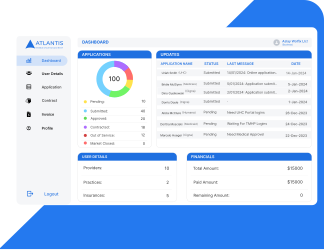
Real-Time Client Report Portal
Access real-time insights into your billing performance with our secure Client Report Portal.Track claims, payments, denials, and KPIs anytime—transparency at your fingertips.
Contact Us