Medicaid, Medicare & ACA Policy Changes: What Americans Need to Know

The U.S. healthcare system is entering another critical transition period. Medicaid, Medicare & ACA Policy Changes expected in 2026 are poised to reshape coverage affordability, eligibility, and reimbursement structures for millions of Americans. From potential shifts in ACA subsidies to evolving Medicaid eligibility rules and Medicare payment updates, these changes will affect not only patients but also providers, healthcare administrators, and revenue cycle management operations.
In the first quarter of 2026, healthcare leaders are already preparing for downstream impacts on medical billing workflows, AR management strategies, and compliance planning. Understanding what’s changing now can help individuals make informed coverage decisions and help healthcare organizations stay financially resilient.
The End of Enhanced ACA Subsidies: What It Means for Americans
One of the most closely watched healthcare policy developments is the potential expiration or restructuring of enhanced ACA subsidies that were introduced to improve healthcare affordability USA. These subsidies significantly lowered monthly premiums for individuals purchasing plans through the Affordable Care Act coverage marketplace.
Why ACA Subsidy Changes Matter
Enhanced subsidies expanded eligibility beyond traditional income thresholds, allowing middle-income households to qualify for premium tax credits. If these enhancements are scaled back or sunset:
Monthly premiums could increase for millions of enrollees
Some individuals may drop coverage due to affordability concerns
Providers could see higher self-pay balances, affecting medical billing collections
These ACA subsidy changes may also increase uncompensated care costs, especially for hospitals and outpatient facilities already facing thin margins.
From a revenue cycle perspective, changes in patient coverage mix often require updates to eligibility verification processes, payer rules, and front-end billing workflows.
How ACA Policy Shifts Affect Healthcare Providers
Beyond patients, policy changes ripple across healthcare operations. When coverage becomes less affordable, providers often experience:
Higher denial rates
Longer AR days
Increased dependency on patient collections
Healthcare organizations must adapt quickly by strengthening eligibility checks, refining coding accuracy, and improving patient financial communication.
Medicaid Eligibility Updates and State-Level Variations
Another major area of transformation involves Medicaid eligibility updates. Medicaid policies are jointly managed by federal and state governments, which means changes rarely happen uniformly across the country.
What’s Changing in Medicaid Policy
States are reassessing eligibility criteria, enrollment redetermination processes, and benefit structures following earlier expansion periods. Key areas of focus include:
Income verification standards
Coverage continuity requirements
Managed care enrollment rules
For beneficiaries, these changes could mean losing coverage if redetermination requirements are not met. For providers, fluctuating Medicaid enrollment often results in retroactive eligibility adjustments, one of the leading causes of claim denials.
Strong AR management systems help organizations track retroactive changes and reduce revenue leakage tied to Medicaid policy shifts.
Medicare Policy Updates 2026: What Providers Should Expect
Medicare remains the backbone of healthcare coverage for older adults, and Medicare policy updates 2026 are expected to focus on cost containment, value-based care, and reimbursement alignment.
Key Medicare Policy Trends
Medicare policy discussions increasingly emphasize:
Payment model refinements
Outpatient and ambulatory reimbursement adjustments
Value-based care participation
Even modest payment updates can significantly impact provider revenue due to Medicare’s scale. Accurate documentation, compliant medical coding, and timely claims submission will be more important than ever.
Healthcare organizations that fail to adjust to Medicare updates often face increased audits, delayed payments, and higher denial rates placing additional pressure on revenue cycle teams.
Healthcare Affordability and Coverage Gaps
At the center of all these changes is one core issue: healthcare affordability USA. When premiums rise or eligibility narrows, coverage gaps widen. These gaps affect:
Preventive care utilization
Chronic condition management
Financial stability for both patients and providers
Policy shifts under the Affordable Care Act coverage framework aim to balance federal spending with access, but transitions are rarely seamless. Patients frequently need guidance navigating new plan options, while providers must manage increased financial responsibility shifting to patients.
This environment makes patient-friendly billing practices and transparent financial communication critical.
Operational Impact on Revenue Cycle Management
Healthcare policy changes don’t just affect coverage, they reshape operations. As Medicaid, Medicare, and ACA rules evolve, providers must update:
Eligibility verification protocols
Coding compliance standards
Claims submission workflows
Outsourced revenue cycle partners often play a key role in managing this complexity. Effective billing strategies can help providers maintain cash flow even during policy transitions.
Mid-cycle functions like charge capture accuracy and end-cycle AR management become especially important when payer rules are in flux.
Preparing for 2026: What Providers Can Do Now
Proactive preparation is essential. Healthcare organizations can reduce disruption by:
Monitoring policy announcements closely
Training staff on updated payer rules
Auditing medical billing and coding processes
Strengthening denial management strategies
These steps help providers stay compliant while protecting revenue as healthcare reforms roll out.
Why These Policy Changes Matter Long-Term
While 2026 will bring immediate adjustments, the long-term implications of Medicaid, Medicare, and ACA policy changes may be even more significant. The direction of health insurance reforms will influence:
Provider reimbursement stability
Patient access to care
The financial sustainability of healthcare systems
Organizations that adapt early, by optimizing revenue cycle workflows and embracing operational efficiency, will be better positioned to thrive despite uncertainty.
Conclusion: Navigating Policy Change with Confidence
Medicaid, Medicare & ACA Policy Changes in 2026 will reshape coverage affordability, eligibility, and reimbursement across the U.S. healthcare system. For providers, success will depend on preparation, compliance, and strong revenue cycle foundations.
If your organization needs expert support in medical billing, medical coding, or AR management during this transition.
Contact Atlantis RCM today to protect your revenue and stay ahead of healthcare policy change.
Our Services


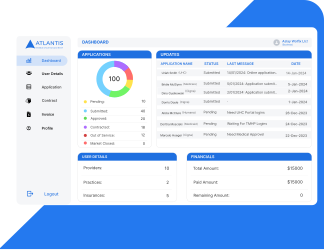
Real-Time Client Report Portal
Access real-time insights into your billing performance with our secure Client Report Portal.Track claims, payments, denials, and KPIs anytime—transparency at your fingertips.
Contact Us