Medical Billing Audit vs. Routine Billing Review: Are You Looking Deep Enough?

Your billing team may be checking claims every day.
Payments are posted. Denials are worked. Corrections are made. Accounts are followed up.
But here's the question many practice owners do not ask:
Are you only correcting individual billing problems, or are you looking for patterns that could be affecting your practice's revenue?
A recurring billing error can appear minor when you look at one claim. When the same issue occurs across dozens or hundreds of claims, however, the financial impact can become much more significant.
That is where the difference between a routine billing review and a medical billing audit matters.
A routine review helps you monitor current billing activity. A medical billing audit takes a deeper look at claims, coding, payments, denials, documentation, and other defined areas to determine what recurring findings may be telling you about the billing process.
Medical Billing Review vs. Medical Billing Audit: What's the Difference?

What Is a Routine Medical Billing Review?
A routine medical billing review is generally part of a practice's ongoing billing oversight.
It may involve reviewing recent claims, payment records, patient accounts, denials, or other selected billing activity to identify obvious discrepancies and make corrections.
The focus is usually on current activity and immediate action.
What Does a Routine Billing Review Check?
Depending on the practice and its billing workflow, a routine review may check whether:
Recent claims contain visible errors
Payments were posted correctly
Billing procedures are being followed
Individual accounts require correction
Denials are receiving appropriate follow-up
Claims were submitted within required timeframes
Current transactions meet established expectations
This type of review is useful because billing teams need continuous oversight.
However, routine monitoring can remain focused on individual transactions.
That means a practice may correct one problem without realizing that the same problem is occurring elsewhere.
What Is a Medical Billing Audit?
A medical billing audit is a structured examination of billing activity within a defined scope.
Instead of looking only at whether individual transactions appear correct, an audit can evaluate multiple findings together and look for recurring patterns, process weaknesses, documentation issues, coding concerns, or other areas that deserve closer attention.
The purpose is not simply to find mistakes.
It is to understand why the findings are occurring, how frequently they occur, and what they may indicate about the billing operation.
For physician practices, auditing and internal monitoring are also recognized components of an effective compliance approach. HHS-OIG recommends physician practices conduct internal monitoring and auditing, maintain compliance standards, provide training, and respond appropriately when issues are detected.
Review = Identify
A routine review may identify an incorrect claim.
Audit = Investigate
An audit can examine whether similar findings are occurring across a larger sample or defined billing area.
That distinction becomes especially important when a practice keeps correcting the same type of problem.
What Does a Medical Billing Audit Check?
The scope of an audit depends on the practice's objectives, specialty, payer mix, billing environment, and identified risk areas.
A medical billing audit may examine areas such as:
1. Coding Accuracy
The review may examine whether reported CPT, HCPCS, and ICD-10 codes are supported by the documentation and applicable billing requirements.
Coding accuracy matters because inaccurate coding can affect reimbursement and compliance. OIG specifically highlights accurate coding and billing, including risks such as upcoding and billing for services that were not properly supported.
2. Documentation Support
An audit may compare selected claims against supporting documentation to determine whether the services billed are adequately supported.
The medical record should support the services reported on the claim. OIG emphasizes the importance of accurate and complete documentation and ensuring claims are supported by the medical records.
3. Claims Accuracy
The audit can examine whether claims were submitted correctly and whether recurring claim errors are contributing to rejections, denials, or payment delays.
4. Denial Patterns
One denied claim may be an isolated event.
Repeated denials for the same reason can tell a very different story.
An audit can examine denial trends to determine whether recurring issues involve coding, authorization, eligibility, documentation, payer requirements, claim submission, or another part of the revenue cycle.
5. Payment Posting and Adjustments
A billing audit may review whether payments, contractual adjustments, write-offs, and other transactions are being recorded consistently.
6. Accounts Receivable
An audit may examine A/R aging and identify patterns such as:
Older unpaid balances
Recurring payer delays
Unworked accounts
Repeated follow-up failures
Increasing high-balance accounts
Unresolved claim issues
7. Revenue Leakage
A deeper review can help identify areas where the practice may be losing revenue through recurring billing problems, missed opportunities, incorrect adjustments, unresolved claims, or other process issues within the defined audit scope.
8. Payer-Specific Issues
If a particular payer consistently produces unusual denials, payment differences, or other problems, an audit can help determine whether the issue is isolated or part of a larger pattern.
10 Signs Your Practice May Need a Medical Billing Audit
Not every billing problem requires a full audit.
But certain patterns should prompt practice leaders to take a closer look.
1. The Same Denials Keep Coming Back
Your team corrects a denial, but the same denial reason continues appearing.
That may indicate the problem is occurring upstream.
2. A/R Is Increasing Without a Clear Explanation
If outstanding balances continue growing while billing activity appears normal, a deeper review can help determine where the problem may be occurring.
3. Your Collection Performance Has Changed
A noticeable change in collections can warrant an examination of claims, payments, payer behavior, adjustments, and other relevant billing activity.
4. You Are Seeing Frequent Coding Corrections
Repeated coding corrections may indicate that the issue deserves more than claim-by-claim correction.
5. Denial Rates Are Difficult to Explain
If your team can tell you how many claims were denied but cannot clearly explain the recurring causes, an audit may provide greater visibility.
6. Write-Offs or Adjustments Are Increasing
Changes in write-offs and adjustments can justify a closer examination of what is driving them.
7. You Recently Added Providers or Locations
Growth can introduce new billing workflows, payer relationships, coding patterns, and operational risks.
8. You Changed Your EHR, PM, or Billing Workflow
System or workflow changes can create new opportunities for billing errors.
9. Your Billing Reports Raise More Questions Than Answers
If you receive reports but still cannot determine where revenue is being delayed, denied, or lost, you may need a more focused assessment.
10. You Have Not Had a Deeper Review of Your Billing Operation
Routine monitoring is valuable, but practices also benefit from periodically asking whether their existing controls are identifying the right problems.
Medical Billing Audit vs. Routine Review: The Biggest Difference Is Depth
A routine review is generally designed to answer:
“Is this transaction correct?”
A medical billing audit asks a broader question:
“What can these findings tell us about the billing operation?”
Consider a simple example.
A practice discovers that one claim was denied because the required authorization was missing.
A routine review may identify the denial and send the claim for appropriate follow-up.
But what happens if the same authorization issue appears on 40 more claims?
Now the question changes.
The practice needs to understand whether there is:
A workflow problem
A communication issue
A payer-specific requirement being missed
A staff training gap
A system configuration issue
A recurring authorization process failure
The individual claim is no longer the whole story.
The pattern is the story.
Can a Medical Billing Audit Identify Revenue Leakage?
It can help identify billing findings that may contribute to revenue leakage within the audit scope.
Revenue leakage does not always come from one large mistake.
It can develop through repeated smaller issues, such as:
Claims not being submitted correctly
Recurring denials
Unresolved A/R
Coding inconsistencies
Missed or incorrect billing opportunities
Payment discrepancies
Incorrect adjustments
Documentation-related billing issues
Repeated payer-specific problems
A useful audit therefore does more than produce a list of errors.
It should help practice leadership understand:
What happened?
How often is it happening?
Where is it happening?
What may be causing it?
Which findings deserve attention first?
The goal is to turn billing data into actionable information.
Medical Billing and Coding Audit: Are They the Same?
Not necessarily.
A medical billing audit can examine broader revenue cycle and billing activity.
A medical billing and coding audit places greater emphasis on coding-related findings and whether reported services are supported by documentation and applicable coding requirements.
For example, an audit may identify:
Incorrect code selection
Modifier concerns
Documentation discrepancies
Coding patterns that require further review
Claims that do not appear consistent with supporting documentation
Not every coding discrepancy indicates intentional misconduct.
The important point is to identify the finding, understand its cause, and determine the appropriate corrective action.
For practices participating in federal healthcare programs, accurate claims and documentation are especially important. OIG notes that physicians' documentation forms the basis for claims and that inaccurate claims can create compliance concerns.
What About Denials?
Denials are one of the clearest examples of why an audit can provide more insight than routine claim follow-up.
Suppose your billing team works 100 denied claims.
They correct each claim individually.
The claims are resubmitted.
But the same denial reason continues appearing the following month.
The team is working hard, but the underlying problem may still exist.
A deeper review can examine:
Which denial reasons occur most often
Which payers generate the most recurring denials
Which providers or locations are affected
Whether similar claims have the same problem
Whether the issue originates before claim submission
Whether corrective action has actually reduced recurrence
The objective is not merely to work denials faster.
It is to understand why they keep happening.
When Is a Routine Billing Review the Better Choice?
A routine review may be appropriate when your objective is to:
Monitor current billing activity
Check selected transactions
Correct isolated discrepancies
Maintain regular quality controls
Review recent claims and payments
Keep billing operations on track
For everyday oversight, this level of monitoring may be exactly what your practice needs.
A full audit is not necessary for every billing issue.
The right approach depends on the question you are trying to answer.
When Should a Practice Consider a Medical Billing Audit?
A deeper audit may make sense when routine monitoring is no longer providing enough clarity.
Consider an audit when:
Similar problems keep recurring
Denials remain high despite repeated corrections
A/R performance is difficult to explain
Coding concerns appear across multiple claims
Payment discrepancies are becoming more common
Billing performance changes without an obvious reason
You want to evaluate a new billing process
Your practice has experienced significant operational changes
You want an independent assessment of billing performance
You need a deeper understanding of potential revenue leakage
The purpose is not to audit simply because an audit sounds more comprehensive.
The purpose is to match the depth of the review to the problem you are trying to understand.
How Do Routine Reviews and Audits Work Together?
Routine reviews and audits should not be viewed as competing processes.
They can work together.
Routine review → Monitor
Audit → Investigate
Corrective action → Address
Ongoing monitoring → Verify
This creates a practical cycle for stronger billing oversight.
A routine review can identify an emerging issue.
If that issue continues or appears across multiple claims, a deeper audit can investigate the pattern.
The findings can then guide corrective action and future monitoring.
HHS-OIG's physician compliance guidance similarly emphasizes monitoring and auditing, followed by appropriate response and corrective action when problems are detected.
What Happens After a Medical Billing Audit?
An audit should not end with a spreadsheet full of errors.
The findings should help answer what happens next.
A practical post-audit process may include:
Identify
Document the findings and determine where they occurred.
Prioritize
Separate isolated issues from recurring or higher-priority findings.
Investigate
Look for potential process causes behind recurring findings.
Correct
Address appropriate billing, coding, workflow, or training issues.
Monitor
Track the relevant metrics to determine whether the issue continues.
This is where an audit becomes useful to practice leadership.
The objective is not simply to produce a report.
It is to help the practice understand what needs attention.
How Often Should a Medical Practice Have a Billing Audit?
There is no single audit schedule that fits every practice.
Frequency can depend on factors such as:
Practice size
Claim volume
Specialty
Payer mix
Billing complexity
Previous audit findings
Operational changes
Identified risk areas
Changes in billing or coding processes
Rather than following an arbitrary schedule, practices should consider their specific risk and monitoring needs.
For physician practices, OIG guidance supports ongoing internal monitoring and auditing as part of a broader compliance approach.
If your practice has a specific compliance concern, suspected overpayment, or potential legal issue, a qualified healthcare compliance or legal professional may also be appropriate. OIG recommends consulting experienced healthcare counsel for legal evaluation and risk analysis when needed.
A Simple Example: Why One Claim Does Not Tell the Whole Story
Imagine a practice discovers one claim with an incorrect modifier.
The claim is corrected.
Problem solved?
Maybe.
But now imagine the same modifier issue appears across 75 claims.
The problem is no longer one incorrect claim.
It may point to a recurring coding or billing process issue.
That is the value of looking beyond individual transactions.
A routine review can tell you that something went wrong.
An audit can help you determine whether the same thing is happening elsewhere and where further investigation may be needed.
Which Approach Gives Your Practice More Insight?
It depends on what you need to know.
Choose a routine billing review when you need ongoing monitoring and correction of individual billing activity.
Consider a medical billing audit when you need to understand recurring findings, unexplained performance changes, potential revenue leakage, coding or documentation concerns, or broader billing patterns.
The key is not choosing the more complicated option.
It is choosing the level of review that answers the question your practice actually has.
Is Your Practice Looking Deep Enough?
If your billing team is correcting the same problems repeatedly, the issue may not be the individual claim.
It may be the process behind the claim.
A deeper medical billing audit can help practice leaders move from:
“What went wrong with this claim?”
to:
“Why does this keep happening?”
That shift can give you a clearer view of billing performance, recurring issues, and areas that may deserve corrective action.
If you are unsure whether your practice needs a routine billing review or a deeper audit, Atlantis RCM can assess your billing environment and help identify areas that warrant closer attention.
Request a Free Medical Billing Audit
Frequently Asked Questions
1. Is a medical billing audit the same as a routine billing review?
No. A routine billing review generally focuses on monitoring selected billing activity and correcting individual discrepancies. A medical billing audit takes a more structured approach to examining findings within a defined scope and identifying recurring patterns or broader concerns.
2. What does a medical billing audit include?
The scope can vary by practice, but an audit may examine coding, documentation, claims, denials, payments, adjustments, A/R, payer-specific issues, and other defined areas of the revenue cycle.
3. When should a practice choose an audit instead of a routine review?
A routine review may be appropriate for everyday monitoring and isolated issues. A deeper audit may be appropriate when problems recur, performance changes without a clear explanation, or practice leadership needs a broader understanding of billing activity.
4. Can a medical billing audit identify recurring denial problems?
Yes. An audit can examine denial findings across a defined population to determine whether recurring patterns exist and whether those patterns may point to underlying billing, coding, authorization, eligibility, documentation, or workflow issues.
5. Can a billing audit identify revenue leakage?
It can help identify billing findings that may contribute to revenue leakage within the audit scope, such as recurring denials, unresolved A/R, payment discrepancies, coding issues, or other process-related problems.
6. Is a medical billing audit only about finding mistakes?
No.
A useful audit should go beyond identifying individual errors. It should help the practice understand patterns, prioritize findings, and determine where corrective action or further investigation may be appropriate.
7. Is a coding audit the same as a billing audit?
Not necessarily.
A coding audit focuses primarily on coding accuracy and supporting documentation. A broader medical billing audit may examine coding along with claims, denials, payments, A/R, adjustments, and other billing processes.
8. How often should a practice conduct a billing audit?
There is no universal schedule. The appropriate frequency depends on the practice's size, specialty, billing volume, risk areas, previous findings, operational changes, and monitoring needs.
9. Can a billing audit help reduce denials?
It can help identify recurring denial causes and areas where corrective action may be needed. The objective is to address repeated causes rather than repeatedly correcting individual claims.
10. What should a practice do after an audit?
The practice should review the findings, prioritize important or recurring issues, investigate potential causes, implement appropriate corrective actions, and continue monitoring the affected areas.
Final Takeaway
A routine billing review and a medical billing audit serve different purposes.
Routine review: Monitor and correct.
Medical billing audit: Examine, investigate, and understand.
If your practice is seeing recurring billing problems, unexplained A/R growth, persistent denials, coding concerns, or other patterns that routine monitoring has not fully explained, a deeper audit may provide the additional insight you need.
The goal is not to audit everything.
The goal is to look deeply enough to understand what your billing data is telling you.
If you want a closer look at your practice's billing performance, request a free medical billing audit from Atlantis RCM.
Our Services


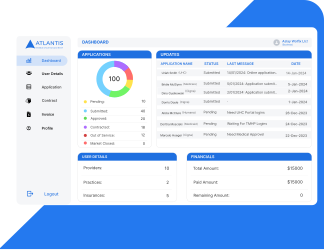
Real-Time Client Report Portal
Access real-time insights into your billing performance with our secure Client Report Portal.Track claims, payments, denials, and KPIs anytime—transparency at your fingertips.
Contact Us