Allowed Billing Amounts and How They Affect Your Costs

Medical billing is often seen as a maze of confusing terms and complex numbers. One concept that stands out as critical for patients and providers alike is the allowed amount.
This figure determines what insurance companies pay, what patients owe, and how providers manage write-offs. Understanding it ensures transparency, avoids surprise bills, and supports accurate reimbursements.
What Is the Allowed Amount in Medical Billing?
In simple terms, the allowed amount is the maximum sum an insurance company considers payable for a covered service, supply, or procedure. It may also be called the eligible expense, negotiated rate, or payment allowance.
For example, if a provider charges $300 for a service and the insurer’s allowed amount is $200, the insurer pays its share based on the allowed amount (e.g. 80% = $160), and the patient pays the remaining $40. Any difference between the billed charge and allowed amount is written off if the provider is in-network.
This mechanism ensures both patient protection and provider revenue stability.
How Insurers Set Allowed Amounts
Insurance companies use several factors to determine allowed amounts:
Contracts and Fee Schedules
Providers who join insurance networks agree to fixed rates for services based on CPT codes. These contractual rates are regularly updated to reflect cost changes, policy adjustments, and healthcare market trends.
CPT and HCPCS Codes
Every service corresponds to a CPT or HCPCS code, each linked to a specific reimbursement rate. Accurate coding is essential; errors or missing modifiers can reduce payments or result in claim denials.
Geographic and Network Differences
Rates differ across locations. Urban areas may have higher allowed amounts than rural regions. Similarly, in-network providers benefit from contracted rates, while out-of-network providers are usually reimbursed based on “reasonable and customary†charges, which can leave patients with higher costs.
In-Network vs. Out-of-Network Providers
Understanding network status is key to knowing patient responsibility.
In-Network Providers accept the allowed amount as full payment. Patients are responsible only for their deductible, copay, or coinsurance. The difference between the billed charge and allowed amount becomes a contractual write-off, protecting patients from excessive costs.
Out-of-Network Providers, on the other hand, may balance bill patients. This means the patient could be responsible for the difference between the provider’s charge and the insurer’s allowed amount.
While federal protections like the No Surprises Act limit this in emergencies and certain facility-based care, elective services can still carry higher costs.
Reading Your EOB Statement
Your EOB statement is the key to understanding how claims are processed. It shows:
The billed amount: the provider’s initial charge.
The allowed amount: the insurer’s maximum payable sum.
Insurance payment: the portion covered by the insurer.
Patient responsibility: the deductible, copay, or coinsurance applied to the allowed amount.
For instance, a $300 billed service with a $200 allowed amount might result in the insurer paying $160 and the patient paying $40. The $100 difference is written off for in-network providers.
The Role of CPT Codes in Allowed Amounts
CPT codes are the backbone of medical billing. Each code represents a specific service or procedure and is tied directly to reimbursement. Accurate coding is critical for medical coding accuracy and impacts the allowed amount. Modifiers may adjust payment when multiple procedures are performed, and proper documentation is required to avoid denials or reduced payments.
By ensuring CPT codes are accurate and complete, providers can avoid delays, minimize errors, and secure correct payment based on the allowed amount.
Managing Calculations and Patient Responsibility
For in-network claims, the difference between billed charges and allowed amounts becomes a write-off. Patients are only responsible for their share of the allowed amount, shielding them from inflated bills. Out-of-network providers may leave patients liable for additional costs if balance billing occurs.
Providers should maintain careful documentation and verify allowed amounts against contracts to prevent payment discrepancies.
Common Pitfalls and How to Avoid Them
Misunderstandings around allowed amounts often arise from:
Balance billing: Unexpected bills from out-of-network providers.
Coding errors or missing authorizations: These can reduce allowed amounts or lead to denials.
Discrepancies on EOB statements: Patients should always review and compare them with provider bills.
Effective communication with insurers and accurate documentation are essential to prevent these issues.
Conclusion
Understanding the allowed amount in medical billing is key for both patients and providers, as it directly impacts insurance payments, patient responsibility, and revenue management.
By adopting a modern medical billing solution, you can streamline claims, reduce errors, and improve transparency across your healthcare organization.
Take control of your revenue cycle and boost patient trust today with Atlantis RCM! start optimizing now!
FAQs
1. What is the allowed amount in medical billing?
The allowed amount is the maximum sum an insurer will pay for a service, forming the basis for patient and provider payments.
2. How does it differ from the billed charge?
The billed charge is the provider’s price, while the allowed amount is insurer-approved and typically lower.
3. How do CPT codes affect the allowed amount?
Each service has a CPT code that determines reimbursement, and modifiers or missing documentation can impact payments.
4. Who pays if a provider charges more than the allowed amount?
In-network providers write off the excess; out-of-network providers may bill patients unless protections apply.
5. What is balance billing?
Balance billing occurs when patients are charged the difference between the provider’s fee and the insurer’s allowed amount.
6. How can providers avoid underpaid or denied claims?
By using a medical billing solution that ensures coding accuracy, proper documentation, and real-time error alerts.
Our Services


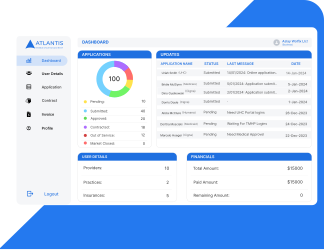
Real-Time Client Report Portal
Access real-time insights into your billing performance with our secure Client Report Portal.Track claims, payments, denials, and KPIs anytime—transparency at your fingertips.
Contact Us