Medicare Enrollment and CMS Credentialing Simplified

For healthcare providers, nothing is more frustrating than delayed payments or outright denials because of incomplete Medicare credentialing. Without proper CMS approval, you can’t bill Medicare or Medicaid and that means interrupted cash flow, frustrated patients, and lost revenue.
At Atlantis RCM, we take the guesswork out of Medicare provider enrollment and CMS credentialing. Our experts guide providers through every step, ensuring you stay compliant, get approved faster, and never risk being placed on the CMS “red list.â€
Understanding CMS Credentialing Requirements
CMS credentialing is the process of verifying a provider’s qualifications, compliance record, and eligibility to participate in federal healthcare programs. Every U.S. provider physicians, nurse practitioners, therapists, facilities, and telehealth providers must complete this process before billing Medicare or Medicaid.
Key CMS Requirements:
Valid National Provider Identifier (NPI) via NPPES
Active, unrestricted state medical license
Correct CMS-855 enrollment forms or PECOS submission
Proof of malpractice insurance (at least $1M per claim / $3M annual)
Signed Medicare Participation Agreement
Ongoing compliance with HIPAA, CoPs, CfCs, and MIPS reporting
Passing background checks (OIG exclusions, criminal history, malpractice history)
The Role of PECOS Enrollment System
The PECOS Enrollment System (Provider Enrollment, Chain, and Ownership System) is the digital gateway for Medicare provider enrollment. Instead of filling out stacks of paper forms, PECOS allows healthcare providers to complete their applications online, upload documents, and track enrollment status in real time.
But while PECOS speeds up the process, it also introduces new challenges. CMS rejects thousands of applications every year because of mismatched data, incomplete entries, or outdated records. For example, if the information in your NPI profile doesn’t exactly match the details in PECOS even a small spelling difference your application may be returned for correction, delaying approval by weeks.
The Role of a Medicare Administrative Contractor (MAC)
After your enrollment application is submitted through PECOS or paper forms, it doesn’t go directly to CMS headquarters. Instead, it is reviewed by a Medicare Administrative Contractor (MAC) , a private organization contracted by CMS to oversee credentialing, claims processing, and compliance for a specific region of the United States.
The MAC plays a critical role in verifying every detail of your submission. They review:
State licensure and board certifications
Malpractice insurance coverage
NPI and taxonomy codes
Supporting documents such as IRS verification and CMS-855 forms
If even one piece of documentation is missing or inaccurate, the MAC will issue a request for additional information. Providers usually have 7–14 days to respond. Failure to do so can result in outright denial or closure of the application. This is where many providers lose valuable time and face revenue delays.
Credentialing Mistakes That Delay Enrollment
Many providers unknowingly repeat the same mistakes:
Submitting the wrong CMS-855 form
Letting licenses expire before submission
Leaving PECOS applications incomplete
Missing revalidation deadlines every 3–5 years
Failing to respond to MAC information requests
At Atlantis RCM, we proactively track credentialing deadlines, manage renewals, and build a compliance buffer protecting you from the costly cycle of denials and resubmissions.
Telemedicine Credentialing Rules
Telehealth has expanded rapidly, but Medicare credentialing for telemedicine adds new challenges:
Active license required in every state where patients are located
Use of HIPAA-compliant platforms for video, chat, and data sharing
Patient consent documentation for telehealth visits
CMS-compliant prescribing and supervision standards
Failure to meet these rules may result in denied claims or non-compliance penalties.
Delegated Credentialing
Large healthcare groups and organizations often rely on delegated credentialing with Credentialing Verification Organizations (CVOs). This arrangement speeds up processing but comes with strict CMS oversight.
Delegated entities must:
Have a written agreement with defined responsibilities
Undergo annual audits and monitoring
Conduct primary-source verification of provider credentials
Maintain accessible, accurate documentation
Even under delegation, the contracting organization remains accountable for compliance with CMS standards.
Compliance Beyond Approval
Credentialing is not a one-time task. CMS requires ongoing compliance that includes periodic background checks, updated malpractice insurance certificates, and consistent participation in quality reporting programs. Site visits may also occur, verifying that the listed practice location exists, signage matches, and patient-care areas meet safety standards.
Providers who treat credentialing as a one-and-done event often find themselves unprepared when CMS requests updates or conducts inspections. Continuous monitoring and documentation are just as important as the initial approval.
Credentialing Software: Transforming Medicare Enrollment
Traditional Medicare enrollment can take more than ten hours per provider, often involving dozens of documents, multiple forms, and back-and-forth communication with CMS. Every small error or omission creates delays that directly affect cash flow. This is why credentialing software has become a critical tool for modern practices.
How Credentialing Software Works
1. Data Collection and Profile Setup
The process begins with gathering provider details such as education, training, licensure, NPI, malpractice coverage, and IRS records. Instead of relying on manual entry, credentialing software pulls this data directly from primary sources and creates a comprehensive provider profile. This ensures that the information is accurate, consistent, and ready for submission.
2. Automated Form Population
CMS-855 forms and PECOS submissions often require providers to enter the same details multiple times. Credentialing software eliminates redundancy by auto-filling forms with the stored profile data. This not only speeds up the process but also reduces the risk of human error that can cause denials or delays.
3. Real-Time License and Credential Verification
Credentialing platforms integrate with state licensure boards and national databases. They continuously verify provider licenses, DEA registrations, and board certifications, ensuring that only valid and up-to-date credentials are submitted. This live verification prevents applications from being rejected due to expired or mismatched information.
4. Compliance Tracking and Revalidation Alerts
One of the biggest risks in Medicare credentialing is missing revalidation deadlines, which occur every three to five years. Software tools track these timelines automatically and send reminders well before expiration dates. Practices are notified of upcoming renewals, license expirations, or policy updates, avoiding costly interruptions in billing privileges.
5. Document Management and Secure Storage
Credentialing requires a large volume of documents, from malpractice insurance certificates to IRS verification letters. Software platforms provide centralized, secure storage for all records. Providers and administrators can access these files instantly during audits, inspections, or MAC reviews, eliminating the chaos of paper-based systems.
6. Status Monitoring and Reporting
A major advantage of credentialing software is visibility. Dashboards show the real-time status of each application, pending approvals, and outstanding requirements. Detailed reports highlight bottlenecks, track processing times, and ensure that no step is overlooked. This transparency allows practices to anticipate delays and address them proactively.
Conclusion
Medicare provider enrollment and CMS credentialing are detailed, time-sensitive processes that directly affect your revenue and compliance. From PECOS submissions and MAC reviews to background checks, telemedicine rules, and software-driven automation, every step must be handled with precision. Missing even a single requirement can lead to denials, delays, or lost income.
Don’t let credentialing slow your practice down. Atlantis RCM is here to simplify the process, accelerate approvals, and keep your revenue cycle protected.
Ready to get approved faster and eliminate the stress of Medicare credentialing?
Contact Atlantis RCM today and take the guesswork out of Medicare provider enrollment.
FAQs
1. What is CMS credentialing and why is it important?
CMS credentialing is the process of verifying a provider’s qualifications, compliance history, and eligibility to bill Medicare and Medicaid. Without it, claims are denied, and providers cannot receive reimbursements for patient care.2. How long does Medicare provider enrollment take?
The timeline varies but typically takes 30 to 90 days if all documents are correct. Delays usually occur because of incomplete PECOS applications, incorrect CMS-855 forms, or missing documentation requested by a Medicare Administrative Contractor (MAC).3. What documents are required for CMS credentialing?
Providers need an active state license, National Provider Identifier (NPI), malpractice insurance certificate, completed CMS-855 form or PECOS application, IRS verification of Tax ID, and signed Medicare Participation Agreement.4. How often do providers need to revalidate or re-credential with CMS?
CMS requires revalidation every three to five years. Providers receive a notice six months before expiration. Missing this deadline can result in termination of billing privileges.5. What is the difference between PECOS and CMS-855 forms?
PECOS is the online portal for Medicare enrollment, while CMS-855 forms are the paper-based versions. Providers must use one method per enrollment cycle, not both.6. Are there special credentialing rules for telemedicine providers?
Yes. Telehealth providers must hold an active license in every state where patients are located, use HIPAA-compliant platforms, and obtain documented patient consent before delivering virtual care.7. What is delegated credentialing?
Delegated credentialing allows a healthcare group or Credentialing Verification Organization (CVO) to handle credentialing tasks on behalf of providers. However, the organization remains fully accountable for meeting CMS requirements and is subject to regular audits.Our Services


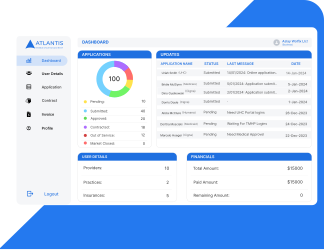
Real-Time Client Report Portal
Access real-time insights into your billing performance with our secure Client Report Portal.Track claims, payments, denials, and KPIs anytime—transparency at your fingertips.
Contact Us