Medicare Payment Cuts in 2025

"A cut is still a cut. And you'd have to do extra things just to break even." — Dr. Steven Furr, AAFP Board Chair
Medicare payment cuts in 2025 are hitting doctors and hospitals hard, especially those already stretched thin, like rural clinics. This year’s 2.93% reduction marks the fifth straight cut, and it’s showing up at the worst possible time. Everything from medical supplies to staff wages is getting more expensive.
Dr. Steven Furr put it plainly: if you’re facing a 2.8% pay cut and also missing a 3.5% inflation update, you're effectively losing over 6%.
Doctors say the gap between what Medicare pays and what care actually costs is growing fast. Some are thinking about dropping Medicare entirely, while others are forced to rush through more patients in less time. Add in staff shortages and the rise of Medicare Advantage, and the pressure is piling up. Here's a quick look at what’s changing in 2025 and why it matters. This timeline illustrates how key legislation from 1985 to 2025 including MACRA, QPP, and the 2025 cut—has shaped physician pay under Medicare. These shifts continue to drive concerns about sustainability and reform.

Medicare Advantage Payment Cuts
If you’ve noticed it’s getting harder for doctors to actually provide care under Medicare Advantage plans, you’re not imagining things. The pressure is real and it’s only getting worse.
According to healthcare attorney Brian Kern, insurers are tightening the reins: “The insurers go to hospitals and say, ‘We’re not going to reimburse this.’ That’s where the tension starts.†Why? Because CMS is cutting back what it pays these insurers, and in turn, they’re passing that pressure down to providers.
Now nearly 99% of Medicare Advantage patients need prior authorization for even basic services. That’s a huge jump compared to traditional Medicare. For doctors, this means mountains of paperwork, more denials, and less time actually treating patients. For patients, it often means delays in care and a lot of confusion along the way.
Hospital Outpatient Prospective Payment System
Starting in 2025, hospitals are facing a whole new list of requirements especially when it comes to maternity care. They’ll need to maintain specific staffing levels, go through regular audits, and make sure their teams are fully trained to handle emergencies.
On paper, these changes are meant to improve safety and lower maternal mortality rates and that’s a good thing. But here’s the catch: many hospitals say they simply don’t have the budget or staff to keep up. Smaller facilities, especially in rural areas, are sounding the alarm. Without more funding, some might have to scale back services or even shut their doors altogether.
How Medicare Pays Physicians
According to the Medicare government the physician fee schedule determines payments based on Relative Value Units (RVUs) for each service. In 2025, CMS implemented a 2.83% reduction in the conversion factor from $33.89 to $32.74leading to an average 2.93% cut. "If a typical E/M visit got $100, the 2025 payment would be $97.17," explained Pam D'Apuzzo of VMG Health.
CMS claims that primary care doctors could see a 1% bump if they use code G2211 for ongoing care. But Dr. Furr warns: "That estimate is misleading... you'd have to do extra documentation just to get up to level."
Affordable Care Act Medicare Cuts
While the Affordable Care Act helped millions gain health coverage, it came with a cost literally for hospitals and doctors. To help fund expanded access, the law included long-term Medicare reimbursement cuts that are still affecting providers today.
These reductions were meant to control federal spending, but many in the medical field say the trade-off has made it harder to sustain care especially in rural or underserved areas where every dollar counts.
"We haven't had an inflation update for 21 years," said Dr. Furr. "Can you imagine any business still surviving that way?"
Quality Payment Program
The Quality Payment Program (QPP), created by MACRA, seeks to tie physician pay to quality. However, the Merit-Based Incentive Payment System (MIPS) has drawn criticism for excessive paperwork and weak incentives. Only a fraction of clinicians receive positive adjustments, and many are exempt.
CMS is transitioning to MIPS Value Pathways (MVPs), which bundle reporting around specific specialties. Yet, many question whether these changes go far enough. Calls for a simplified, voluntary alternative payment model are growing.
Three Physician Pay Challenges in 2025
"Opting out of Medicare is certainly a consideration for many providers."—Pam D'Apuzzo, VMG Health
1. Stagnant Reimbursement: The 2.93% cut combined with inflation means real income losses. Some specialties are hit harder, and the promised gains from G2211 are conditional at best.
2. Medicare Advantage Expansion: More patients are enrolling in Medicare Advantage, but rising administrative hurdles and denials are straining providers.
3. Staff Shortages: A projected RN shortage of 78,610 FTEs by 2025 will force clinics to spend more on recruitment and retention, while risking burnout among remaining staff.
What Physicians Can Do
- Advocate: Support legislation like H.R.10073 to reverse cuts and tie updates to inflation. "Write to your Congressperson. Get active with AAFP and AMA," urged Dr. Furr.
- Use G2211 Strategically: Apply it only when the ongoing complexity of care justifies its use.
- Engage Payers: Negotiate with Medicare Advantage plans and review authorization workflows.
- Retain Staff: "People leave when they feel fed up," noted consultant Kathryn Moghadas. Improve workflow and morale before hiring becomes harder.
Conclusion: Staying Afloat Amid Cuts
Medicare payment cuts in 2025 represent a crossroads. Physicians must choose between adapting, advocating, or exiting the Medicare program. While CMS and Congress debate reforms, practices must act to protect revenue and preserve patient access.
We support providers through every billing and compliance challenge. We accept major insurers, including Medicare and Medicaid, and help streamline your revenue cycle to weather the storm.
Don't navigate this alone. Contact Atlantis RCM to learn how we can support your practice in 2025 and beyond.
FAQs
What are Medicare payment cuts in 2025?
Medicare payment cuts in 2025 refer to a 2.93% reduction in the Physician Fee Schedule conversion factor, lowering reimbursement for doctors and other clinicians treating Medicare patients.
Why did Medicare reduce physician payments in 2025?
The cuts are due to budget neutrality requirements and the expiration of a temporary payment boost from 2024. CMS is required by law to offset any increase in payment for certain services by reducing others.
How do Medicare Advantage payment cuts affect providers?
Medicare Advantage plans receive less funding from CMS, so they often respond with stricter prior authorization rules and lower provider reimbursements, making it harder for physicians to deliver timely care.
What is the Hospital Outpatient Prospective Payment System (OPPS)?
The OPPS is a Medicare payment system that reimburses hospitals for outpatient services. In 2025, new staffing and training requirements—especially in maternity care—are placing financial strain on hospitals.
How does Medicare determine physician payments?
Medicare uses the Physician Fee Schedule, which is based on Relative Value Units (RVUs) assigned to each service. These are adjusted annually by a conversion factor, which was reduced by 2.83% in 2025.
What are Affordable Care Act Medicare cuts?
These cuts were introduced to help fund expanded insurance coverage under the ACA. They reduce payments to providers, which some argue negatively impacts care access in underserved areas.
What is the Quality Payment Program (QPP)?
QPP is a CMS initiative that links Medicare payments to care quality. It includes MIPS (for most providers) and A-APMs (for value-based care participants). Critics say MIPS is too complex and under-incentivized.
Can physicians opt out of Medicare?
Yes. Some physicians consider opting out due to reduced reimbursement and administrative burdens. However, most still participate in the program to maintain access for Medicare patients.
What is code G2211 and why does it matter in 2025?
Code G2211 is an add-on payment for complex, ongoing care. CMS estimates it may increase primary care reimbursements slightly, but only if used consistently—and with extra documentation.
How can physicians respond to Medicare payment cuts?
Doctors can advocate for legislation like H.R.10073, use billing codes strategically (like G2211), improve efficiency with payers, and focus on staff retention to manage costs and maintain care access.
Our Services


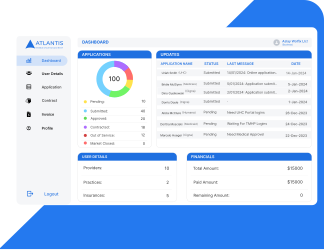
Real-Time Client Report Portal
Access real-time insights into your billing performance with our secure Client Report Portal.Track claims, payments, denials, and KPIs anytime—transparency at your fingertips.
Contact Us