Outsource Medical Billing: A Practical Guide for U.S. Healthcare Providers

Medical billing can look manageable when a practice has a few providers and a small billing team.
Then the volume grows.
Claims need to go out faster. Payers request more documentation. Denials need follow-up. Aging accounts receivable start piling up. Staff turnover creates gaps. Coding questions take time to resolve. And someone still has to monitor whether payments are actually coming in as expected.
That is why many U.S. healthcare providers consider outsourcing their medical billing.
But outsourcing is not simply about handing your claims to another company.
The right medical billing partner should help your practice submit cleaner claims, follow up on unpaid accounts, address denials, improve revenue visibility, and reduce the administrative workload on your internal team.
This guide explains how medical billing outsourcing works, what services you can outsource, what it can cost, the benefits and risks, and how to determine whether outsourcing makes sense for your practice.
What Does It Mean to Outsource Medical Billing?
Outsourcing medical billing means hiring an external medical billing company or revenue cycle management (RCM) partner to handle some or all of your practice's billing operations.
Depending on your agreement, the outsourced team may manage:
Patient eligibility and insurance verification
Charge entry
Medical coding
Claim submission
Claim tracking
Payment posting
Denial management
Accounts receivable follow-up
Underpayment identification
Patient billing support
Appeals
Insurance follow-up
Billing audits
Revenue cycle reporting
Some practices outsource their entire billing operation. Others keep certain responsibilities in-house and outsource specific areas such as coding, denial management, or A/R follow-up.
CMS itself recognizes the administrative burden associated with healthcare transactions and notes that standardized electronic administrative processes can reduce administrative work and healthcare costs.
The important question is not simply:
“Should we outsource our billing?”
It is:
“Which parts of our revenue cycle should be handled internally, and which should be managed by specialists?”
Why Are Medical Practices Outsourcing Billing?
Healthcare reimbursement has become too complex for billing to be treated as a simple back-office task.
A single patient encounter can involve eligibility, authorization, documentation, coding, claim submission, payer edits, payment posting, and potentially an appeal.
A problem at any stage can affect reimbursement.
For example:
- Incorrect patient information → claim rejection
- Coding or documentation issue → denial
- Missed payer follow-up → aging A/R
- Incorrect payment → underpayment goes unnoticed
- Unworked denial → lost revenue
This is why outsourcing can be attractive to practices that do not have the staff, systems, or specialized expertise to consistently manage every part of the revenue cycle.
Recent industry guides continue to identify denial management, claim submission, A/R follow-up, coding, compliance, and staffing as major considerations when evaluating medical billing outsourcing.
What Medical Billing Services Can You Outsource?
Medical billing outsourcing does not have to mean giving an outside company control over everything.
You can outsource individual functions or the entire billing workflow.
1. Insurance Eligibility and Verification
Before a service is provided, your team needs accurate information about the patient's coverage.
An outsourced team can verify:
- Active insurance coverage
- Patient benefits
- Deductibles
- Copayments
- Coinsurance
- Coverage limitations
- Out-of-network status
- Authorization requirements
Accurate verification can help identify coverage issues before they turn into avoidable billing problems.
2. Medical Coding
Medical coding connects the patient's clinical documentation with the codes used for billing.
Depending on the service, this can involve:
- ICD-10-CM
- CPT
- HCPCS
- E/M coding
- Modifiers
- Specialty-specific coding requirements
Coding accuracy matters because errors can affect reimbursement, compliance, and claim processing.
CMS reported that incorrect coding accounted for 49.1% of improper payments for overall Medicare E/M codes in its 2024 reporting period, while insufficient documentation accounted for another 34.1%.
That makes coding review an important part of a well-managed revenue cycle.
3. Charge Entry
Charge entry ensures services provided by your practice are accurately entered into the billing system.
A billing team may review:
- Patient information
- Provider information
- Dates of service
- Procedures
- Diagnosis codes
- Modifiers
- Units
- Place of service
Missing or incorrect information at this stage can create problems later in the claim lifecycle.
4. Claims Submission
The billing team prepares and submits claims to the appropriate payer.
This can include:
- Claim scrubbing
- Payer-specific requirements
- Electronic claim submission
- Rejected claim correction
- Claim status tracking
- Resubmission
The goal is not simply to send more claims.
It is to submit accurate, complete claims that have a better chance of being processed correctly the first time.
5. Denial Management
Denials should not simply be corrected and resubmitted.
A strong denial management process asks:
Why was this claim denied?
Then:
Is the same issue affecting other claims?
Common denial categories include:
- Eligibility issues
- Missing information
- Coding errors
- Authorization problems
- Medical necessity
- Duplicate claims
- Timely filing
- Documentation requirements
- Incorrect modifiers
- Coordination of benefits
CMS also maintains programs designed to help providers identify and reduce claim errors, including initiatives focused on medical review and denial reduction.
Effective denial management therefore involves both recovery and prevention.
6. Accounts Receivable Management
A claim is not finished simply because it was submitted.
Your practice still needs to know:
- Has the payer processed it?
- Was it paid correctly?
- Was it denied?
- Is additional documentation required?
- Is an appeal needed?
- How long has the balance been outstanding?
An outsourced A/R team can prioritize unpaid claims based on factors such as aging, balance, payer, and denial reason.
7. Payment Posting
Payment posting allows the practice to accurately record:
- Insurance payments
- Patient payments
- Adjustments
- Contractual allowances
- Denials
- Refunds
Accurate payment posting also gives management better visibility into the financial performance of the practice.
8. Appeals and Payer Follow-Up
When a claim is denied, the next step may be correction, reconsideration, or appeal.
An outsourced billing team can help:
- Identify the denial reason
- Gather supporting information
- Prepare appeal documentation
- Track appeal status
- Follow up with the payer
- Monitor recurring payer issues
7 Benefits of Outsourcing Medical Billing
The biggest reason to outsource should not be that another company can perform administrative tasks.
The real value is what better billing management can do for the practice.
1. Reduce the Administrative Burden
Physicians and practice managers should not have to spend their days chasing unpaid claims.
Outsourcing allows your internal staff to focus more on patient-facing and practice operations while billing specialists manage the revenue cycle.
2. Access Specialized Billing Expertise
Medical billing requires knowledge of:
- Payer rules
- Coding
- Claims
- Denials
- Appeals
- A/R
- Documentation
- Reimbursement processes
A specialized billing company can maintain a team focused on these areas instead of relying on one or two employees to handle everything.
3. Improve Claim Follow-Up
A claim that is not followed up on can remain unpaid for weeks or months.
Outsourced billing teams can establish structured workflows for monitoring claims and prioritizing outstanding balances.
4. Identify Revenue Leakage
Revenue leakage does not always come from large mistakes.
It can happen through:
- Missed charges
- Incorrect coding
- Underpayments
- Unworked denials
- Untimely follow-up
- Incorrect adjustments
- Aging A/R
Regular reporting and billing audits can help identify where revenue is being lost.
5. Reduce Dependence on One Employee
One of the overlooked risks of in-house billing is staff dependency.
If your only experienced biller leaves, your practice can suddenly lose valuable knowledge about:
- Payer requirements
- Workflows
- Outstanding claims
- Denial patterns
- A/R
- Practice-specific billing procedures
An outsourced team can provide greater operational continuity.
6. Gain Better Revenue Visibility
A good billing partner should not simply send you a monthly collection number.
You should be able to understand what is happening inside your revenue cycle.
Useful KPIs may include:
- Clean claim rate
- Denial rate
- Net collection rate
- Days in A/R
- A/R aging
- First-pass acceptance
- Payment turnaround
- Collection trends
- Denial categories
- Appeal outcomes
7. Scale With Your Practice
Your billing operation should be able to handle changes in:
- Provider count
- Patient volume
- Locations
- Specialties
- Payer mix
- Services
- New procedures
Outsourcing can make it easier to add billing capacity without immediately hiring, training, and managing additional internal staff.
Outsourced Medical Billing vs. In-House Billing
There is no universal answer for every practice.
The right choice depends on your size, specialty, claim volume, staffing, technology, and revenue cycle performance.
Factor | In-House Billing | Outsourced Billing |
| Staffing | Practice manages hiring | Billing company provides team |
| Training | Internal responsibility | Vendor responsibility |
| Billing expertise | Depends on staff | Specialized billing resources |
| Scalability | Requires additional hiring | Can expand with practice needs |
| Management | Practice supervises billing team | Vendor manages billing operations |
| Technology | Practice invests in systems | Often included in service |
| Denial follow-up | Internal team | Dedicated billing specialists |
| A/R management | Internal responsibility | Can be outsourced |
Reporting Staff turnover risk | Depends on internal setup Practice bears it | Usually included in service Vendor manages team continuity |
The decision should ultimately be based on total cost and financial performance, not simply the salary of one biller.
How Much Does It Cost to Outsource Medical Billing?
Medical billing outsourcing costs vary depending on the billing model, specialty, claim volume, services included, and complexity of the practice.
Common pricing structures include:
Percentage of Collections
The billing company charges a percentage of collections.
For example, if a practice collects $100,000 and the agreed fee is 5%, the billing fee would be $5,000.
Flat Fee Per Claim
Some billing companies charge a fixed amount based on the number of claims processed.
Monthly Fee
Some providers offer a fixed monthly fee based on practice size and service scope.
Hybrid Pricing
Some arrangements combine a base fee with additional charges for specific services.
The important point is to compare the total cost of billing, not just the quoted percentage.
Your calculation should consider:
- Salaries
- Benefits
- Payroll taxes
- Billing software
- Clearinghouse fees
- Training
- Recruitment
- Staff turnover
- Management time
- Denial recovery
- A/R follow-up
- Coding support
- Compliance processes
- Technology
Industry sources discussing 2026 outsourcing models also emphasize that pricing can vary significantly depending on the scope of services and practice requirements.
When Should a Medical Practice Consider Outsourcing Billing?
Outsourcing may be worth evaluating if your practice is experiencing several of these problems:
Your A/R keeps increasing
If older balances continue to accumulate, the problem may be more than claim volume.
Denials are taking too much staff time
If your team spends hours correcting and resubmitting claims, specialized denial management may help.
Your billing employee is overloaded
One person may be able to manage billing for a small practice until volume or complexity increases.
Your biller recently left
A staffing change can expose weaknesses in billing processes and create a backlog.
Payments are taking too long
Delayed reimbursement can put unnecessary pressure on practice cash flow.
You cannot easily explain your billing KPIs
If management does not know the practice's denial rate, A/R aging, collection rate, or major denial reasons, there may be a visibility problem.
Your practice is expanding
Adding providers, locations, specialties, or patient volume can quickly increase billing complexity.
You are spending too much time on billing
If practice leadership is repeatedly pulled into claim and payer issues, it may be time to evaluate another model.
Should Small Medical Practices Outsource Billing?
Yes, outsourcing can make sense for medical billing services for small practices, but size alone should not determine the decision.
A small practice may benefit when it does not have enough volume to justify a full internal billing department.
For example, a small practice may need expertise in:
- Claims submission
- Coding
- Denial management
- A/R follow-up
- Insurance verification
- Payment posting
Hiring separate specialists for every function may not be practical.
Outsourcing can give the practice access to a broader billing team without requiring the practice to build every role internally.
The better question is:
Can the practice manage its revenue cycle accurately and consistently with the resources it currently has?
If the answer is no, outsourcing deserves consideration.
What Should You Look for in a Medical Billing Company?
Choosing a billing company should involve more than comparing prices.
1. Specialty Experience
Ask whether the company has experience with your specialty.
Billing requirements can differ significantly between:
- Primary care
- Behavioral health
- Cardiology
- Orthopedics
- Dermatology
- Physical therapy
- ABA therapy
- Mental health
- Urgent care
- Surgery
- Multispecialty practices
2. Clear Reporting
Ask to see sample reports before signing a contract.
You should know what is happening with your claims and revenue.
3. Denial Management Process
Ask:
How do you identify recurring denial trends?
A company that only resubmits denied claims may not be addressing the underlying problem.
4. A/R Strategy
Ask how the company prioritizes aging accounts.
Do they work all A/R equally, or do they prioritize accounts based on balance, payer, age, and recovery potential?
5. EHR and Practice Management Compatibility
Ask whether the billing company has experience with your systems.
Common platforms include:
- Epic
- Cerner
- eClinicalWorks
- athenahealth
- Kareo/Tebra
- AdvancedMD
- NextGen
- DrChrono
The specific technology matters less than whether the billing workflow can integrate effectively with your practice.
6. HIPAA and Security Practices
Your billing partner may handle protected health information, so security and compliance should be evaluated before sharing patient information.
Ask about:
- HIPAA policies
- Access controls
- Data security
- Employee training
- Business Associate Agreement
- PHI handling
- Incident response
HIPAA Administrative Simplification requirements cover electronic healthcare transactions, including claims and payment transactions.
7. Communication
You should know:
- Who manages your account?
- How often will you receive reports?
- Who handles urgent billing issues?
- How quickly are questions answered?
- How are escalations handled?
A billing company should feel like an extension of your operations, not a black box.
10 Questions to Ask Before Outsourcing Medical Billing
Before signing a contract, ask these questions:
- How many practices do you currently support?
- Do you have experience with my specialty?
- Which billing functions are included in your fee?
- How do you measure claim and billing performance?
- How do you handle denied claims?
- How do you manage aging A/R?
- Which EHR and practice management systems do you support?
- How do you protect PHI and maintain HIPAA compliance?
- What reports will my practice receive?
- How will you measure success during the first 90 days?
That last question is particularly important.
A good outsourcing relationship should have measurable expectations.
What Are the Risks of Outsourcing Medical Billing?
Outsourcing is not automatically better.
The wrong billing partner can create new problems.
Loss of visibility
If your billing company does not provide useful reporting, you may know less about your revenue cycle than you did before outsourcing.
Poor communication
Billing issues can become frustrating when your team cannot get timely answers.
Lack of specialty knowledge
A general billing team may not understand the specific coding and payer requirements of your specialty.
Hidden fees
A low initial quote can become expensive if services such as coding, A/R follow-up, appeals, or patient billing are charged separately.
Poor transition management
Moving billing operations without a proper transition plan can create claim backlogs and missed follow-ups.
Compliance concerns
Healthcare organizations need to carefully evaluate how vendors access, transmit, and protect PHI.
The solution is not to avoid outsourcing.
It is to vet the billing partner properly before handing over your revenue cycle.
How to Transition From In-House to Outsourced Medical Billing
A billing transition should be planned rather than rushed.
Step 1: Review Your Current Revenue Cycle
Establish a baseline for:
- Monthly collections
- A/R
- A/R aging
- Denial rate
- Clean claim rate
- Days in A/R
- Net collection rate
- Outstanding claims
Step 2: Identify Your Biggest Problems
Is the main issue:
- Coding?
- Denials?
- A/R?
- Staffing?
- Claim submission?
- Payment posting?
- Reporting?
Knowing this makes it easier to choose the right outsourcing model.
Step 3: Choose the Scope
Decide whether you need:
Partial outsourcing
or
Full medical billing and RCM support.
Step 4: Establish Access and Workflows
Your billing partner will need appropriate access to the systems required to perform its responsibilities.
Step 5: Set KPIs
Define measurable targets before implementation.
Step 6: Review Performance Regularly
Do not wait six months to discover that the arrangement is not working.
Review performance regularly and compare results against your baseline.
What KPIs Should Your Billing Company Report?
A strong medical billing report should help you understand the financial health of your practice.
At minimum, consider tracking:
Clean Claim Rate
The percentage of claims accepted without requiring correction.
Denial Rate
The percentage of claims denied by payers.
Net Collection Rate
How effectively your practice collects the reimbursement it is entitled to receive.
Days in A/R
How long outstanding balances remain in accounts receivable.
A/R Aging
The distribution of outstanding balances by age.
First-Pass Acceptance Rate
How many claims are accepted without requiring additional work.
Payment Posting Turnaround
How quickly payments are posted after receipt.
Denial Recovery
How much previously denied revenue is recovered.
These metrics can help practice leaders move from simply asking:
“How much did we collect?”
to asking:
“Why did we collect this amount, where are we losing revenue, and what needs to change?”
Is Outsourcing Medical Billing Worth It?
For many practices, it can be.
But the goal should not be outsourcing for the sake of outsourcing.
The goal is to create a billing operation that is:
- Accurate
- Consistent
- Measurable
- Compliant
- Responsive
- Financially effective
If your internal team already delivers those results at a sustainable cost, keeping billing in-house may make sense.
If billing problems are consuming staff time, increasing A/R, creating avoidable denials, or making revenue difficult to predict, outsourcing may be worth evaluating.
The best decision comes from comparing your current billing performance and total cost against what a qualified partner can realistically deliver.
Why Practices Choose Atlantis RCM for Medical Billing Outsourcing
At Atlantis RCM, we work with U.S. healthcare providers that need additional support across their billing and revenue cycle operations.
Our services can include:
- Virtual Medical Assistant
- Revenue cycle management
- Medical Billing
- Medical coding
- Claims management
- Denial management
- A/R management
- Payment posting
- Medical Credentialing
- Prior authorization
- Practice management
- Patient help desk
- Medical billing audits
We support healthcare organizations across 30+ specialties, with services designed around the specific needs of each practice.
Rather than treating billing as simply claim submission, our approach looks at the revenue cycle from the front end through payment and A/R follow-up.
That means looking at where claims are being lost, why denials are occurring, what is happening with aging A/R, and whether your billing processes are producing the financial results your practice expects.
Thinking About Outsourcing Your Medical Billing?
Before changing billing companies or hiring another in-house biller, it can help to understand where your current revenue cycle stands.
Get a free medical billing audit from Atlantis RCM to identify potential billing errors, denial trends, A/R issues, and revenue opportunities.
Book Your Free Medical Billing Audit
Frequently Asked Questions
What is outsourced medical billing?
Outsourced medical billing means hiring an external billing company or RCM provider to manage some or all of a healthcare practice's billing operations, including claims, coding, payment posting, denials, and A/R follow-up.
Is outsourcing medical billing cheaper than hiring an in-house biller?
It can be, but there is no universal answer. Practices should compare the total cost of internal billing, including salaries, benefits, software, training, management, turnover, and revenue leakage, against the complete cost of outsourcing.
What services can be outsourced?
Practices can outsource individual functions such as coding, claims management, denial management, payment posting, or A/R follow-up, or outsource the entire revenue cycle.
Is medical billing outsourcing safe?
It can be when the provider follows appropriate security and HIPAA requirements. Practices should evaluate data security, access controls, employee training, PHI handling, and the Business Associate Agreement before working with a billing company.
Can small medical practices outsource billing?
Yes. Small practices often outsource because maintaining a specialized in-house billing team may not be practical. The appropriate model depends on patient volume, specialty, staffing, billing complexity, and financial performance.
How long does it take to switch to an outsourced billing company?
The timeline depends on the practice, systems, payer mix, data migration requirements, and scope of services. A proper transition should include planning, system access, workflow documentation, staff communication, and baseline KPI measurement.
How do I know if my practice needs outsourced billing?
Look at your denial rate, A/R aging, collection performance, staffing capacity, claim follow-up, billing errors, and management workload. If these areas are consistently creating problems, outsourcing may be worth evaluating.
Final Takeaway
Medical billing outsourcing is not simply about moving work outside your practice.
It is about deciding whether your practice can manage the revenue cycle effectively with its current people, processes, technology, and expertise.
For some providers, an in-house team remains the right choice.
For others, outsourcing can provide access to specialized billing expertise, stronger claim follow-up, better denial management, more consistent A/R work, and clearer revenue reporting without building every function internally.
The right partner should be able to show you what is happening in your revenue cycle, where money is being lost, what they will do about it, and how success will be measured.
That is the standard healthcare providers should use when evaluating outsourced medical billing services.
Our Services


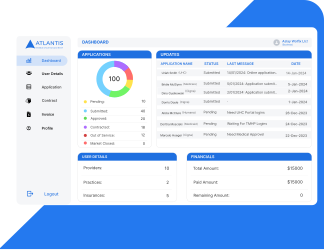
Real-Time Client Report Portal
Access real-time insights into your billing performance with our secure Client Report Portal.Track claims, payments, denials, and KPIs anytime—transparency at your fingertips.
Contact Us