Documentation Gaps That Lead to Payment Delays in Medical Billing

Documentation Gaps That Lead to Payment Delays are one of the biggest reasons medical practices struggle with cash flow and overall revenue cycle management performance.
Many practices focus on seeing more patients, but revenue still moves slowly. Claims sit in review. Payments arrive late. Follow-ups increase. Staff gets frustrated.
Most of the time, the problem is not the payer.
It’s not the fee schedule.
It’s not even the code.
It’s missing, unclear, or incomplete documentation.
Let’s break down the top 10 documentation gaps that quietly delay payments and what you can do to avoid them.
1. Missing Medical Necessity Explanation
Payers want a clear reason why a service was needed, not just what was done.
When documentation does not clearly connect the diagnosis to the service, claims often go into manual review. This is one of the most common medical billing documentation errors uncovered during billing audits.
A short but clear explanation saves weeks of delay.
2. Incomplete Patient Demographics
Even small details like a missing address or incorrect date of birth can stop a claim from moving forward.
Incomplete patient data often causes front-end rejections, leading to a payment delay in medical claims that could have been avoided before submission.
Accuracy at registration matters more than most practices realize.
3. Weak or Generic Clinical Notes
Notes that are copied, vague, or too short raise red flags.
Payers review clinical notes to verify services. If notes don’t support the level of care billed, the claim stalls. Strong insurance claim documentation helps payers approve claims faster without extra requests.
4. Missing Provider Signatures
Unsigned notes are a silent payment killer.
Payers require authenticated records. Without a provider signature or proper electronic authentication, claims are delayed even if everything else is correct.
This gap alone causes unnecessary revenue cycle management delays in many small practices.
5. Mismatch Between CPT Codes and Notes
If the procedure code does not match what’s written in the documentation, payment slows down.
This mismatch often leads to audits or reviews and increases documentation errors that could be prevented with accurate medical coding and internal validation.
6. Incomplete Time-Based Documentation
For time-based services, time must be clearly documented.
Without start time, end time, or total duration, payers hesitate to release payment. This leads to longer payment delay in medical claims, especially for therapy and evaluation services.
7. Lack of Supporting Attachments
Some services require additional records, reports, or referrals.
When attachments are missing, claims are not denied immediately but they are delayed. Complete insurance claim documentation ensures claims move through payer systems smoothly and reduces follow-up workload.
8. Overuse of Templates
Templates save time but only when customized.
Payers can detect repeated language across claims. Overused templates weaken credibility and increase revenue cycle management delays due to added scrutiny.
9. Inconsistent Documentation Across Visits
When documentation changes tone, detail, or diagnosis without explanation, payers pause.
Consistency helps establish trust and supports proactive denial prevention strategies that keep claims moving instead of stalling.
10. No Internal Documentation Review Process
Many practices submit claims without reviewing documentation first.
This lack of review leads to avoidable gaps, rework, and slower payments. Strong internal checks are part of smart denial prevention strategies that protect revenue.
Why These Gaps Hurt More Than You Think
Here’s the real issue:
Documentation gaps don’t always cause denials.
They cause delays.
Delayed payments affect:
Monthly cash flow
Staff productivity
Follow-up workload
Provider confidence in billing
And over time, they quietly drain revenue.
Fixing documentation is not just a compliance task, it’s a financial strategy.
Midway through the revenue cycle, Documentation Gaps That Lead to Payment Delays create bottlenecks that grow bigger the longer they go unnoticed.
How Practices Can Fix This
High-performing practices focus on:
Clear, simple clinical narratives
Consistent documentation standards
Pre-submission checks
Ongoing education for providers
Revenue-focused documentation reviews
These small changes dramatically reduce payment friction.
Conclusion
Documentation Gaps That Lead to Payment Delays are preventable but only when practices treat documentation as part of revenue, not just record-keeping.
Clean documentation speeds up approvals, reduces follow-ups, and protects long-term cash flow. The practices that win are not billing harder, they’re documenting smarter.
Ready to eliminate payment delays caused by documentation gaps?
Atlantis RCM helps practices identify hidden documentation risks and strengthen end-to-end revenue cycle workflows to get paid faster.
Connect with Atlantis RCM to strengthen your billing and get paid faster
Our Services


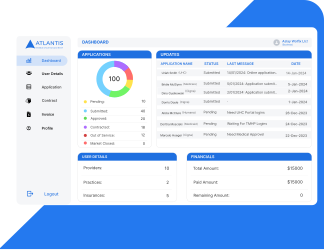
Real-Time Client Report Portal
Access real-time insights into your billing performance with our secure Client Report Portal.Track claims, payments, denials, and KPIs anytime—transparency at your fingertips.
Contact Us