What Are 403(b) Maximum Contribution Limits?

For employees in the medical billing and healthcare administration field, understanding retirement planning is crucial. One of the most important factors is knowing your 403(b) maximum contribution limits.
A 403(b) plan is a tax-advantaged retirement savings account available to employees of public schools, hospitals, and certain non-profit organizations, including healthcare billing companies. Like a 401(k), it allows employees to contribute pre-tax (traditional) or after-tax (Roth 403(b)) money, helping secure a financially stable retirement.
For medical billing professionals, who often work in public or non-profit hospitals, maximizing contributions to a 403(b) plan ensures you can grow your retirement savings efficiently, take advantage of employer matching contributions, and avoid IRS penalties.
Standard 403(b) Contribution Limits
The IRS sets annual limits on how much employees can contribute to their 403(b) accounts. For most medical billing professionals under 50, the limits for 2024–2026 are:
2024: $23,000
2025: $23,500
2026: $24,500
These limits apply to combined contributions to both traditional and Roth 403(b) accounts. For example, in 2026, a medical billing employee could contribute $12,000 to a traditional 403(b) and $12,500 to a Roth 403(b) without exceeding the total limit. Using this strategy effectively boosts retirement savings while avoiding IRS penalties.
Total Combined Employee and Employer Contribution Limits
Your contributions are only part of the picture. Employers often provide matching contributions or additional discretionary contributions to your 403(b) account. For employees in the medical billing sector, employer contributions are particularly valuable because:
They are pre-tax and count toward your total combined limit.
They can help you reach the annual maximum faster.
They are essentially free money that boosts your retirement savings.
The total combined contribution limit (employee + employer) increases slightly each year:
2024: $69,000
2025: $70,000
2026: $72,000
It’s important to note that you cannot contribute more than your total salary from that employer in a given year.
Catch-Up Contributions for Medical Billing Professionals
Many medical billing professionals become eligible for catch-up contributions as they age or reach milestone service years. These contributions allow employees to save more in their peak earning years:
Standard Catch-Up (Age 50+): Add $7,500–$8,000 on top of the standard contribution, helping increase overall retirement savings.
Enhanced Catch-Up (Ages 60–63): Introduced by the SECURE 2.0 Act, allows an additional $11,250, offering maximum opportunity to grow retirement funds.
15-Year Service Catch-Up: Employees with 15+ years in the same hospital or medical billing organization can contribute up to $3,000 annually, combined with age-based catch-up contributions for optimal savings.
These catch-up contributions are particularly valuable for long-tenured medical billing employees aiming to maximize retirement savings before retirement.
Enhanced Catch-Up for Ages 60–63
Introduced by the SECURE 2.0 Act, this provision allows higher contributions.
2025 & 2026: $11,250 extra contribution, total $34,750–$35,750
Employees choose either the standard or enhanced catch-up. Enhanced catch-ups allow medical billing employees to save more in the critical years before retirement.
15-Year Service Catch-Up
Unique to 403(b) plans, employees with 15+ years at the same employer (common in hospitals) can contribute up to $3,000 per year, capped at $15,000 lifetime.
Can be combined with age-based catch-ups for maximum contribution.
Ideal for long-tenured medical billing professionals to maximize retirement growth.
Employer Contributions and Matching
An employer match is a critical component of maximizing 403(b) benefits for medical billing staff. Employer contributions are pre-tax and count toward your total combined limit, effectively accelerating retirement savings. Common setups include:
50% match on the first 6% of salary: Contribute $3,600, employer adds $1,800.
Dollar-for-dollar match up to 3%: Contribute $1,800, employer adds $1,800.
Ensuring you take full advantage of an employer match is one of the simplest ways to grow your 403(b) account efficiently. Combining this with catch-up contributions and strategic allocation to a Roth 403(b) can significantly increase retirement funds for medical billing professionals.
Roth vs. Traditional 403(b) Contributions
Medical billing employees can choose between:
Traditional 403(b): Pre-tax contributions reduce your taxable income today.
Roth 403(b): After-tax contributions grow tax-free, and qualified withdrawals are tax-free in retirement.
Choosing the right mix depends on your current income, tax bracket, and expected retirement needs. Roth contributions are especially beneficial for younger employees in the healthcare sector or those expecting higher taxes in retirement.
Strategies to Maximize 403(b) Contributions
For medical billing professionals, a well-planned contribution strategy can significantly impact long-term retirement security. Consider these strategies:
Start Early: Begin contributions at the start of the year to take advantage of compound growth.
Increase Gradually: Even small annual increases can add thousands over a career.
Prioritize Employer Match: Ensure you contribute enough to receive full matching contributions.
Leverage Catch-Up Contributions: Use age-based or 15-year service catch-ups when eligible.
Plan for Milestone Years: Ages 50, 60, or 15-year service milestones are opportunities to maximize contributions.
Consider Roth Contributions: Tax diversification helps balance retirement income.
By following these strategies, medical billing employees can confidently maximize their 403(b) retirement savings without exceeding IRS limits.
Comparing 403(b) to 401(k)
While 403(b) plans operate similarly to 401(k)s, there are key differences relevant to medical billing professionals:
Target Audience: 403(b) plans serve public schools, hospitals, and tax-exempt organizations; 401(k)s are common in private sector companies.
15-Year Service Catch-Up: Only available in 403(b) plans, giving long-term employees in hospitals and clinics an extra savings boost.
Investment Options: Historically, 403(b) plans focused on annuities, but many now offer strong mutual fund options.
Contribution Limits: IRS limits are similar for both plans, including catch-up contributions for age 50+.
Medical billing staff should review plan offerings carefully, as available investments and catch-up provisions may vary by employer.
Conclusion
Understanding 403(b) maximum contribution limits is essential for medical billing employees to maximize retirement savings and take full advantage of employer contributions and catch-up provisions.
By starting early, leveraging catch-up contributions, prioritizing employer matches, and considering Roth contributions, you can grow your retirement fund efficiently while staying within IRS limits.
For medical billing professionals looking to streamline revenue, manage claims, and maximize operational efficiency while planning for retirement, Atlantis RCM can provide expert support.
Contact Atlantis RCM today to optimize your billing processes and secure financial growth for your organization.
Our Services


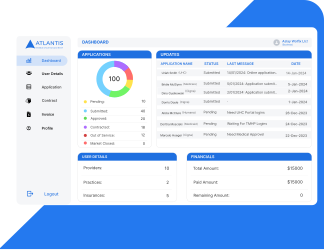
Real-Time Client Report Portal
Access real-time insights into your billing performance with our secure Client Report Portal.Track claims, payments, denials, and KPIs anytime—transparency at your fingertips.
Contact Us